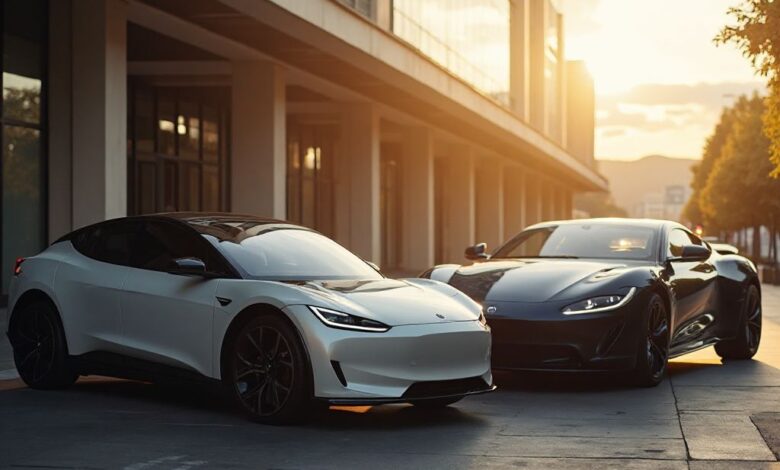
The Silent Revolution: How Electric Vehicle Resale Values Stack Up Against Traditional Gas Cars
Forget everything you thought you knew about electric car depreciation! For years, conventional wisdom dictated that electric vehicles (EVs) were financial black holes, plummeting in value faster than a lead balloon in a vacuum. But the automotive landscape is shifting at an electrifying pace, and with it, the narrative around EV resale values is undergoing a dramatic transformation. The truth, as we’ll explore, is far more nuanced and, for many, surprisingly optimistic.
The Million-Dollar Question: Why Resale Value Matters More Than Ever
In an era of rising interest rates, longer loan terms, and rapidly evolving technology, understanding a vehicle’s depreciation is paramount. For most car buyers, a vehicle purchase is one of the largest financial decisions they’ll make outside of a home. The difference between a car that holds its value well and one that doesn’t can amount to thousands of dollars over just a few years, directly impacting your total cost of ownership, your ability to upgrade, and your overall financial health. As the automotive industry sprints towards an all-electric future, with new EV models hitting showrooms almost weekly, the question of how these battery-powered machines perform on the used market is no longer academic – it’s crucial for both first-time EV adopters and seasoned car enthusiasts looking to make an informed decision.
The Shifting Sands of Depreciation: EVs vs. ICE
The Early EV Story: A Steep Decline
In the nascent days of electric mobility, early EVs like the first-generation Nissan Leaf and BMW i3 often faced brutal depreciation. Several factors contributed to this:
- Limited Range: Early EVs offered ranges that are now considered modest, leading to significant “range anxiety” for potential second owners.
- Rapid Technological Advancements: Battery technology improved exponentially year over year. A 2015 EV with 80 miles of range quickly looked obsolete next to a 2018 model boasting 150+ miles.
- Immature Charging Infrastructure: The lack of widespread, reliable charging points made used EVs a tougher sell for buyers without dedicated home charging.
- Government Incentives: Generous federal and state incentives for new EVs often made buying new almost as affordable as buying a slightly used model, devaluing the latter.
The Modern EV Landscape: A More Resilient Picture
Today, the story is dramatically different. While EVs still experience depreciation, their value retention has significantly improved, often competing head-to-head with, and sometimes even surpassing, comparable internal combustion engine (ICE) vehicles. This shift is driven by:
- Increased Range & Performance: Modern EVs from brands like Tesla (Model 3, Model Y), Hyundai (Ioniq 5), Kia (EV6), Ford (Mach-E, F-150 Lightning), and Rivian (R1T, R1S) offer ranges comparable to or exceeding many gas cars, coupled with exhilarating performance.
- Maturing Technology: While tech still advances, the pace of *revolutionary* change has slowed, allowing current models to remain competitive for longer. Battery degradation is also less of a concern than initially feared, with most manufacturers offering long warranties (typically 8 years/100,000 miles or more).
- Improved Charging Networks: The expansion of fast-charging networks like Tesla’s Supercharger and Electrify America has alleviated much of the charging anxiety.
- Growing Demand & Awareness: Environmental consciousness, rising fuel prices, and positive media coverage have fueled a surge in EV demand, benefiting used car values.
Traditional Gas Cars: Stable, But Facing New Headwinds
ICE vehicles have long had predictable depreciation curves, influenced by factors like brand reputation (Toyota, Honda often excel), reliability, fuel efficiency, and market segment (trucks and SUVs generally hold value better than sedans). However, they now face their own set of challenges:
- Fuel Price Volatility: Spikes in gas prices can quickly dampen demand for less efficient ICE vehicles.
- Environmental Scrutiny: Increasing regulatory pressure and consumer preference for greener options may subtly erode long-term demand for gas cars, especially in markets eyeing future ICE bans (e.g., California’s 2035 target).
- Technological Stagnation: While ICE powertrains are refined, they lack the “wow” factor of rapidly evolving EV tech, making them feel less cutting-edge over time.
The Interplay: What Drives Value for Both
Regardless of powertrain, common factors still heavily influence resale value:
- Condition and Maintenance: A well-maintained vehicle with a clean history always fetches more.
- Mileage: Lower mileage generally equals higher value.
- Brand Reputation: Established brands with a history of reliability tend to retain value better.
- Market Demand: Popular models and segments will always be more liquid.
- Original MSRP: High initial prices can lead to higher absolute depreciation, even if the percentage is similar. Luxury EVs like the Mercedes-Benz EQS or Audi e-tron, while desirable, often see significant initial depreciation in dollar terms.
Expert Analysis: Insider Insights You Won’t Find Everywhere
Having navigated this market for a decade, here are a few nuanced observations:
- The “Battery Health Premium” is Emerging: As EVs mature, used buyers are increasingly asking for battery health reports, similar to how they check engine compression on an ICE car. Vehicles with documented minimal degradation (often still 90%+ after 5 years) will command a premium. This will become the “CarFax for batteries.”
- The “Incentive Cliff” Effect: New government incentives for EVs, while great for new car buyers, can create a sudden drop in value for *used* EVs that were sold just before the new incentives kicked in. This creates an “incentive cliff” that used buyers can exploit. Savvy buyers will look for models that are a year or two old, just past the initial depreciation hit, but still benefiting from current tech without the full new-car premium.
- Software Updates as Depreciation Dampeners: Brands like Tesla, and increasingly others like Ford (with Power-Up updates for the F-150 Lightning and Mach-E) and Rivian, offer over-the-air (OTA) software updates that can add new features, improve performance, or even extend range. This ability to “future-proof” a vehicle to some extent can slow depreciation, as a 3-year-old model might have features that didn’t even exist when it was new.
- The Luxury EV Paradox: While mainstream EVs are showing robust resale, ultra-luxury EVs (think early Porsche Taycan or Lucid Air) can still experience significant initial depreciation. Their high MSRPs mean larger dollar value drops, and the rapid evolution of premium tech means that a cutting-edge feature today might be standard on a mid-range EV tomorrow.
- The Plug-in Hybrid (PHEV) Sweet Spot: For those wary of full EV depreciation but wanting efficiency, PHEVs like the Toyota RAV4 Prime or BMW 330e are proving to be excellent value holders. They offer significant electric range for daily commutes combined with the familiarity and long-range flexibility of a gas engine, making them highly desirable in the used market as a bridge technology.
Pros and Cons: EV vs. ICE Resale
Electric Vehicle Resale
- Pros:
- Increasingly competitive depreciation rates, sometimes outperforming ICE in certain segments.
- Lower running costs (fuel, maintenance) make them attractive as used buys.
- Potential for OTA updates to maintain relevance.
- Strong demand driven by environmental concerns and tech appeal.
- Cons:
- Battery degradation, though often minimal, remains a psychological hurdle for some buyers.
- Rapid technological advancements can still devalue older models faster.
- Impact of new government incentives on used car prices.
- “Early adopter penalty” for less popular or first-generation models.
Traditional Gas Car Resale
- Pros:
- Generally predictable depreciation curves.
- Established service networks and parts availability.
- Familiarity and broad appeal for many buyers.
- Strong resale for reliable, high-demand models (e.g., Toyota SUVs, Ford F-Series).
- Cons:
- Vulnerable to volatile fuel prices.
- Perceived as “older technology” in an evolving market.
- Potential long-term impact of environmental regulations and future bans.
- Higher maintenance costs over time compared to EVs.
The Final Verdict: An Electrifying Future, But Choose Wisely
The days of automatic, steep depreciation for all electric vehicles are largely behind us. Modern EVs, especially those with competitive range, robust charging infrastructure, and strong brand backing, are demonstrating impressive resilience in the used car market. While the depreciation curve for EVs can still be more volatile than for their ICE counterparts due to rapid technological shifts and the “incentive cliff” effect, the overall trend is positive.
For first-time buyers, this means you no longer need to fear buying an EV will decimate your investment. For experienced car owners, it’s a call to re-evaluate your assumptions. When considering your next purchase, whether it’s a sleek Tesla Model 3, a versatile Ford F-150 Lightning, a family-friendly Kia EV6, or a reliable Toyota RAV4, always factor in the total cost of ownership, which heavily includes depreciation. Do your research, understand the specific model’s market performance, and consider how long you plan to own the vehicle.
The automotive future is undeniably electric, and with increasing maturity in the EV market, the financial picture for ownership, including resale, is becoming clearer and more attractive. So, are you ready to plug into the future? The road ahead looks brighter, and potentially more valuable, than ever before.
What’s your take? Share your experiences with EV or ICE resale values in the comments below!