The Electric Revolution: Why Switching From Gas to EV Is Easier Than Most People Think
What if I told you that the biggest hurdle to owning an electric vehicle isn’t range anxiety, charging infrastructure, or even the initial price tag? What if I told you that for most drivers, the switch from gasoline to electric is not just inevitable, but surprisingly, profoundly easier than they imagine?
As someone who has spent a decade immersed in the automotive world, test-driving everything from supercars to sensible sedans, I’ve witnessed firsthand the seismic shift underway. The perception of EVs as niche, inconvenient, or futuristic gadgets is rapidly dissolving. We’re now in an era where electric cars are mainstream, practical, and in many ways, superior to their internal combustion engine (ICE) counterparts. The truth is, the transition to electric is far less daunting than the headlines often suggest, and in many cases, it simplifies your daily driving life.
The Tipping Point: Why Now is the Time to Go Electric
For years, the conversation around electric vehicles felt like a distant future. Today, it’s a present reality that demands attention from every car buyer and enthusiast. Rising fuel prices, growing environmental consciousness, and unprecedented technological leaps have converged to create a true tipping point. Governments worldwide are pushing for electrification, car manufacturers are pouring billions into R&D, and the sheer variety and capability of EVs available on the market have exploded.
This isn’t just about saving the planet; it’s about saving money, enjoying a superior driving experience, and embracing a simpler, more convenient relationship with your vehicle. The questions that once plagued potential EV owners—”Will I run out of charge?” “Is charging a hassle?” “Are they too expensive?”—are being definitively answered with robust, real-world solutions. It’s time to demystify the electric transition and reveal why it’s a smoother journey than most anticipate.
Unpacking the EV Experience: Range, Charging, and Costs Demystified
Let’s dive into the core aspects that define the EV ownership experience and illustrate why the perceived difficulties are often overblown.
Modern Range: Beyond Range Anxiety
The specter of “range anxiety” looms large in many minds, but it’s largely a ghost of EVs past. Today’s electric vehicles offer ranges that comfortably exceed the daily driving needs of the vast majority of motorists. Mainstream models like the Hyundai Ioniq 5, Kia EV6, Ford Mustang Mach-E, Volkswagen ID.4, and the ubiquitous Tesla Model 3 and Model Y routinely offer EPA-estimated ranges between 250 and 330 miles on a single charge. Premium offerings from Lucid (Air), Mercedes-Benz (EQS), and Rivian (R1T/R1S) push well past 400 miles, rivaling or even surpassing the range of many gasoline cars.
Consider this: the average American drives less than 40 miles per day. Even with a modest 200-mile range EV, you have a five-fold buffer. For weekend trips or longer journeys, the expanding charging infrastructure (which we’ll discuss next) makes planning much less stressful than it used to be. The idea that you’ll be stranded is increasingly a relic of early EV days, not a concern for modern, long-range electric cars.
Charging Convenience: Your Home is Your Fuel Station
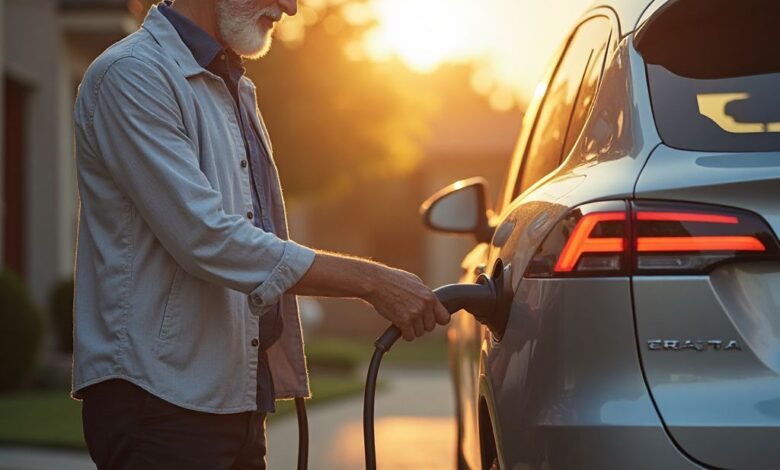
This is arguably the single most transformative aspect of EV ownership and the primary reason the switch is easier than people think. Imagine never having to stop at a gas station again for your daily commute. That’s the reality for most EV owners.
-
Home Charging (Level 1 & Level 2): The vast majority of charging happens at home, overnight. Every EV comes with a Level 1 charger that plugs into a standard 120V wall outlet, providing about 3-5 miles of range per hour. For many, this “trickle charge” is sufficient to replenish daily driving needs. For faster charging, a Level 2 (240V) charger, similar to what a clothes dryer uses, can be installed in your garage. This provides 25-40 miles of range per hour, meaning you wake up to a “full tank” every morning. Brands like ChargePoint, Enel X Way, and Wallbox offer excellent home charging solutions that integrate seamlessly into your smart home.
-
Public Charging: For longer trips, the public charging network has grown exponentially. Networks like Electrify America, EVgo, ChargePoint, and the proprietary Tesla Supercharger network (which is increasingly opening to non-Tesla EVs) offer thousands of fast-charging stations across the country. DC Fast Chargers can add 100-200 miles of range in just 15-30 minutes, turning a coffee break or a quick meal into a charging opportunity. While occasional reliability issues can occur, the overall density and speed of these networks have improved dramatically, making long-distance travel increasingly viable and predictable.
The paradigm shift is profound: instead of planning trips around gas stations, you simply plug in at home, just like your smartphone. Public charging becomes an occasional convenience, not a daily necessity.
Cost Savings: Beyond the Sticker Price
The initial purchase price of an EV can sometimes be higher than a comparable gasoline car, but this is often offset by significant long-term savings and incentives. Many new EVs qualify for federal tax credits (currently up to $7,500 for eligible vehicles and buyers), as well as state and local incentives that can further reduce the effective purchase price. Brands like Chevrolet (Bolt EUV), Ford (F-150 Lightning), and Volkswagen (ID.4) often fall into these incentive categories.
But where EVs truly shine is in running costs:
-
“Fuel” Costs: Electricity is significantly cheaper per mile than gasoline. The precise savings vary by region and electricity rates, but it’s common for EV owners to pay a third to half of what they would for gasoline to travel the same distance. For example, charging a Tesla Model 3 at home typically costs a fraction of fueling a BMW 3 Series.
-
Maintenance: This is a hidden gem of EV ownership. Electric cars have dramatically fewer moving parts than ICE vehicles. There are no oil changes, spark plugs, timing belts, complex transmissions, or exhaust systems to maintain. Brake wear is also reduced thanks to regenerative braking, which uses the electric motor to slow the car and recharge the battery. This translates to substantial savings in routine maintenance over the lifespan of the vehicle. Brands like Audi (e-tron), Porsche (Taycan), and Mercedes (EQS) boast advanced electric drivetrains that are designed for longevity with minimal servicing.
When considering the total cost of ownership (TCO) over 5-10 years, an EV often emerges as the more economical choice, even with a higher initial price.
Expert Analysis: Insider Insights You Won’t Find Everywhere
After a decade of watching the auto industry evolve, here are a few insider insights that truly underscore the ease of the EV transition:
-
The “Invisible” Charging Network: The biggest misconception is that public chargers are the primary way EVs get their “fuel.” In reality, over 80% of EV charging happens at home, silently and conveniently overnight. It’s an invisible network that completely changes the refueling paradigm from an active chore to a passive routine. This is why brands like Ford with their F-150 Lightning, and Rivian with their adventure vehicles, emphasize home charging solutions as a key part of their ecosystem.
-
Beyond the Spec Sheet: The Daily Utility Advantage: While range figures are crucial, the true ease comes from how EVs fit into daily life. The instant torque makes merging onto highways a breeze, the quiet cabin reduces driving fatigue, and the smooth, vibration-free ride is simply more pleasant. These aren’t just “pros”; they’re factors that make every commute and errand genuinely easier and more enjoyable. Think of the seamless acceleration of a Hyundai Ioniq 5 or the refined silence of a BMW iX.
-
Dealer Readiness is Catching Up: Early EV adopters often faced dealerships unprepared to sell or service electric cars. That’s rapidly changing. Manufacturers like Toyota (with the bZ4X), Honda (with upcoming models), and virtually all major players are investing heavily in training staff, installing charging infrastructure at dealerships, and streamlining the EV purchase process. This means a more informed sales experience and reliable service support for new buyers.
-
Software on Wheels: EVs Get Better Over Time: Unlike gasoline cars that are largely static after purchase, EVs, especially those from Tesla, Lucid, and even newer offerings from Kia and Hyundai, frequently receive over-the-air (OTA) software updates. These updates can improve range, charging speed, infotainment features, and even performance. Your car literally gets better, more efficient, and easier to use while you sleep, a concept entirely foreign to the ICE world.
Pros and Cons of the Electric Switch
To provide a balanced view, here’s a quick rundown:
Pros:
- Significantly lower running costs (electricity vs. gasoline).
- Minimal maintenance requirements (no oil changes, spark plugs, etc.).
- Superior driving experience: instant torque, quiet, smooth, refined.
- Environmental benefits (zero tailpipe emissions).
- Home charging convenience: “fuel up” overnight.
- Access to HOV lanes in some areas.
- Government incentives (tax credits, rebates).
- Over-the-air updates improve the car over time.
Cons:
- Higher initial purchase price (though often offset by incentives and TCO).
- Longer “refueling” times compared to gasoline (for public DC fast charging).
- Public charging infrastructure can still be inconsistent in some rural areas.
- Battery degradation over many years (though minimal and covered by warranties).
- Range can be impacted by extreme cold weather or high-speed driving.
Final Verdict: The Future is Now, and It’s Easy
The narrative that switching to an electric vehicle is a complex, compromise-laden endeavor is outdated. For the vast majority of drivers, the transition is not only feasible but offers a simpler, more enjoyable, and often more affordable way to drive. With robust ranges, the unparalleled convenience of home charging, and drastically reduced running costs, the perceived barriers are far smaller than the reality.
From the cutting-edge technology of a Porsche Taycan to the practical utility of a Ford F-150 Lightning, the sheer diversity and capability of today’s EVs mean there’s an electric vehicle for almost every need and budget. Don’t let old myths deter you. The easiest way to truly understand the simplicity and joy of EV ownership is to experience it yourself.
My recommendation? Take the plunge. Visit your local dealerships, test drive a few different models—a Hyundai Ioniq 5, a Tesla Model Y, a Chevrolet Bolt EUV—and talk to owners. You might just find that the future of driving isn’t just exciting; it’s surprisingly, refreshingly easy. The road ahead is electric, and it’s time to enjoy the ride.