The Electrifying Truth: Why Charging Speed is the New Horsepower
Forget the rumble of a V8 or the precise handling of a sports sedan for a moment. In the electrifying world of modern motoring, there’s a new metric dominating conversations, dictating road trip plans, and influencing buying decisions more than ever before: charging speed. It’s a bold statement, perhaps, but the ability to quickly and efficiently replenish your electric vehicle’s battery is, for many, the ultimate performance metric. And if you think all EV charging is created equal, prepare for a jolt of reality.
Navigating the Power Grid: Why Understanding EV Charging Matters Now More Than Ever
The automotive landscape is undergoing its most profound transformation in a century. Electric Vehicles (EVs) are no longer a niche curiosity; they’re mainstream, with models like the Ford F-150 Lightning, Tesla Model Y, Hyundai Ioniq 5, and Rivian R1T gracing driveways and construction sites across the globe. As the EV revolution accelerates, so too does the need for drivers – both seasoned enthusiasts and first-time buyers – to understand the critical infrastructure that powers these machines: the charging ecosystem. Range anxiety, once a significant barrier, is rapidly diminishing, not just because batteries are getting bigger, but because charging options are becoming more diverse, faster, and more accessible. Knowing the difference between Level 1, Level 2, and DC Fast Charging isn’t just technical jargon; it’s the key to unlocking a seamless, enjoyable, and stress-free EV ownership experience. It impacts everything from your daily commute to your cross-country adventures, your electricity bill, and even the longevity of your vehicle’s battery. Let’s demystify it.
The Charging Spectrum: From Trickle to Torrent
Level 1 Charging: The Everyday Outlet
Think of Level 1 charging as the trusty garden hose of the EV world – slow, steady, and always available. This is the simplest form of EV charging, utilizing a standard 120-volt AC (alternating current) household outlet, the kind you plug your toaster or laptop into. Every EV comes with a Level 1 charging cable, often referred to as a “mobile connector” or “occasional use charger,” allowing you to plug directly into any standard three-prong wall socket.
- Specs: Operates at 120V, typically delivering 12-16 amps of current. This translates to a power output of roughly 1.4 to 1.9 kilowatts (kW).
- Charging Speed: This is where Level 1 shows its limitations. You can expect to add a meager 2 to 5 miles of range per hour of charging. For a large battery EV like a Ford F-150 Lightning or a Lucid Air, fully recharging from empty could take days.
- Ideal Use: Level 1 is best suited for Plug-in Hybrid Electric Vehicles (PHEVs) with smaller battery packs, or for EV owners with very low daily mileage needs (e.g., less than 30 miles). It’s also an excellent “emergency” or “top-up” solution when no other charging option is available, or for keeping your battery conditioned while parked for extended periods.
- Costs: The primary cost is your regular electricity bill. There are no additional equipment or installation costs beyond what comes with the car.
- Pros:
- Ubiquitous: Available virtually anywhere there’s a standard electrical outlet.
- No Installation: No special equipment or electrical work required.
- Cost-Effective: Essentially free to set up.
- Cons:
- Extremely Slow: Impractical for daily charging of most modern EVs with larger batteries.
- Limited Range: May not provide enough charge for high-mileage drivers.
Level 2 Charging: The Home Charging Workhorse
Level 2 charging is the sweet spot for most EV owners, offering a significant leap in speed and convenience compared to Level 1. It utilizes a 240-volt AC circuit, similar to what powers large appliances like electric clothes dryers or ovens. To use Level 2 charging, you’ll need a dedicated EVSE (Electric Vehicle Supply Equipment), commonly known as a “charging station” or “wall connector,” installed at your home or accessible at public locations.
- Specs: Operates at 240V, with amperage ranging from 16 to 80 amps, though most residential units typically deliver 32-48 amps. This results in a power output between 3.3 kW and 19.2 kW, with 7-11 kW being the most common for home setups.
- Charging Speed: This is where Level 2 shines. Depending on your car’s onboard charger capacity and the EVSE’s power output, you can expect to add 20 to 60 miles of range per hour. This means most EVs, from a Chevrolet Bolt EV to a BMW i4 or a Tesla Model 3 (with an adapter, as Tesla uses a proprietary connector in North America, though this is changing), can fully recharge overnight (8-12 hours).
- Ideal Use: Level 2 is the go-to for daily home charging, providing ample range for typical commutes. It’s also widely available at workplaces, hotels, shopping centers, and public charging networks (e.g., ChargePoint, EVgo, Electrify America).
- Costs:
- EVSE Unit: $400 – $1,000+ (e.g., Tesla Wall Connector, ChargePoint Home Flex).
- Installation: $500 – $2,000+, depending on your home’s electrical panel capacity and wiring complexity. Some federal, state, or local incentives may help offset these costs.
- Electricity: Your standard electricity rates apply, though many utilities offer special EV rates or time-of-use plans that can make overnight charging very economical.
- Pros:
- Significantly Faster: Provides enough range for daily driving with an overnight charge.
- Convenient: Wake up to a “full tank” every morning.
- Widespread: Abundant public Level 2 chargers.
- Battery Health: Slower, consistent charging is generally considered beneficial for long-term battery health.
- Cons:
- Installation Cost: Initial investment for the EVSE and electrical work.
- Still Hours: Not suitable for quick “refuels” during long road trips.
DC Fast Charging (DCFC) / Level 3: The Pit Stop Powerhouse
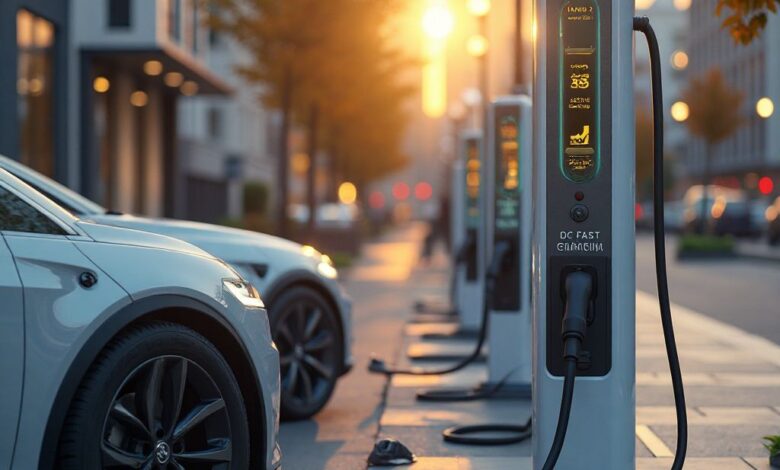
DC Fast Charging, often incorrectly called “Level 3,” is the ultimate solution for rapid charging on the go. Unlike Level 1 and 2, which deliver AC power that the car’s onboard charger converts to DC for the battery, DCFC delivers direct current (DC) directly to the battery, bypassing the onboard charger entirely. This allows for significantly higher power delivery and much faster charging speeds, making it ideal for road trips and situations where time is of the essence.
- Specs: DCFC stations vary wildly in power output, ranging from 50 kW to an astonishing 350+ kW. Common power levels include 50 kW, 150 kW, 250 kW, and 350 kW. Vehicles like the Porsche Taycan, Audi e-tron GT, Hyundai Ioniq 5, Kia EV6, and Lucid Air can take advantage of the ultra-fast 800V architecture and charge at rates exceeding 200 kW. Even 400V systems found in many other EVs, like the Rivian R1T or Ford Mustang Mach-E, can still achieve impressive speeds at 150 kW or more.
- Charging Speed: This is the game-changer. Depending on the charger’s power and your vehicle’s charging capability, you can add 100 to 300+ miles of range in just 15 to 45 minutes. The goal is often to get from 10% to 80% State of Charge (SoC) as quickly as possible, as charging speeds typically taper off significantly after 80% to protect the battery.
- Ideal Use: Essential for long-distance travel, road trips, or when you need a quick top-up in a hurry. DCFC stations are typically found along major highways, at dealerships, and in high-traffic urban areas. Networks include Tesla Superchargers (historically proprietary but now opening up to other brands), Electrify America, EVgo, and ChargePoint.
- Costs: DCFC is generally the most expensive per kilowatt-hour (kWh). Pricing structures vary: some charge per minute, some per kWh, and some have session fees. Costs can range from $0.30/kWh to $0.60/kWh or more, often significantly higher than home electricity rates.
- Pros:
- Extremely Fast: Enables long-distance travel with minimal downtime.
- Convenient for Road Trips: Mimics the quick refueling experience of gasoline cars.
- Growing Network: Infrastructure is expanding rapidly, especially with major players like Electrify America and the ongoing expansion of Tesla’s Supercharger network to non-Tesla vehicles.
- Cons:
- Highest Cost: Most expensive per kWh.
- Availability: While growing, still less ubiquitous than Level 2.
- Potential Bottlenecks: Can experience queues at popular stations during peak travel times.
- Battery Considerations: Frequent, very high-speed charging can put more stress on the battery, though modern battery