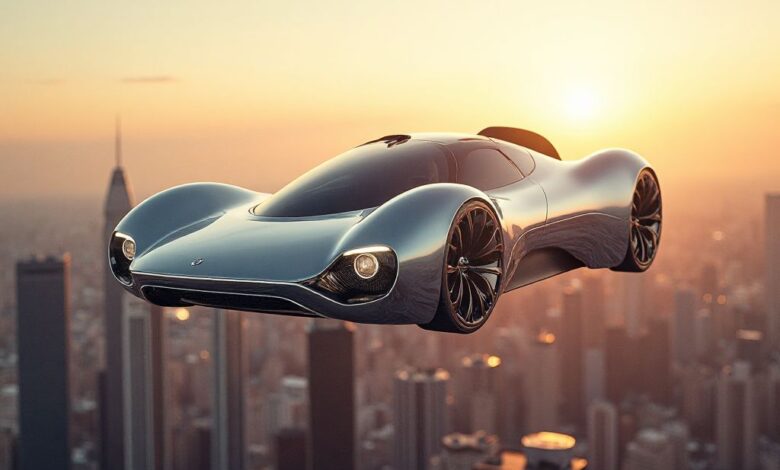
The Sky’s the Limit? Latest Updates on Flying Cars and When They Might Become Real
Imagine this: It’s a Monday morning, and instead of inching through bumper-to-bumper traffic, you hail an air taxi that whisks you above the gridlock, delivering you to your destination in a fraction of the time. This isn’t a scene from a sci-fi movie anymore; it’s a future many companies are actively building, and some are even taking pre-orders. While true “flying cars” that seamlessly transition between road and air remain largely a dream, the era of electric Vertical Take-Off and Landing (eVTOL) aircraft, often dubbed “air taxis,” is closer than you think, with significant advancements pushing them from concept to imminent reality.
Why the Hype Around Flying Cars Matters Today
For decades, the idea of flying cars has captivated our collective imagination, a perennial promise of future mobility. But why does this topic resonate so strongly with car buyers and enthusiasts today, even as we grapple with the shift to electric vehicles and advanced driver-assistance systems? The answer lies in the evolving landscape of urban mobility and our insatiable desire for efficiency. As cities become denser and infrastructure struggles to keep pace, ground-based transportation faces increasing bottlenecks. Flying cars, or more accurately, urban air mobility (UAM) vehicles, offer a tantalizing solution to congestion, promising to unlock a third dimension for travel.
This isn’t just about avoiding traffic; it’s about redefining convenience, accessibility, and even real estate value. For first-time buyers, it represents a glimpse into a future where car ownership might evolve into mobility-as-a-service. For experienced car owners, it’s a potential upgrade to their daily commute, a leap beyond even the fastest performance cars. The technological advancements driving eVTOLs – particularly in battery technology, electric motors, and autonomous flight systems – are often shared with the automotive sector, creating a fascinating synergy between ground-based and aerial innovation. Brands like Hyundai, Toyota, and Stellantis, major players in the traditional automotive world, are investing heavily, signaling that this isn’t just a niche aviation pursuit but a significant part of the broader mobility revolution.
The Ascent of Urban Air Mobility: A Detailed Look
When we talk about “flying cars” today, it’s crucial to differentiate. The vision of a vehicle that drives on the road, folds its wings, and takes off from your driveway is largely still in the experimental phase. What’s truly gaining traction are eVTOL aircraft – essentially electric helicopters or multi-copters designed for short-haul passenger or cargo transport within urban and suburban environments. These are primarily intended for ride-sharing services, operating from designated “vertiports” rather than your garage.
Key Players and Their Progress
- Joby Aviation: Often considered a frontrunner, Joby has significant backing from Toyota and has made substantial progress in FAA certification. They’ve completed numerous test flights and are working towards launching commercial air taxi services, potentially as early as 2025, initially with pilots. Their five-seater aircraft boasts impressive range and speed, aiming to connect city centers with airports or suburban hubs.
- Archer Aviation: Partnered with Stellantis (the parent company of Jeep, Ram, etc.), Archer is another major contender. They recently completed successful test flights of their Midnight aircraft and are also targeting commercial operations in the mid-2020s. United Airlines has already placed a significant pre-order, signaling confidence in Archer’s vision for airport shuttle services.
- Lilium: Hailing from Germany, Lilium stands out with its unique ducted fan design, which aims for quieter operation and higher speeds. They’ve garnered investment from various sources and are focusing on inter-city connections rather than just urban hops. Their certification efforts are progressing with EASA (European Union Aviation Safety Agency).
- Hyundai’s Supernal: The South Korean automotive giant is not just dabbling; they’ve formed Supernal, a dedicated urban air mobility division, with an ambitious vision for both passenger and cargo eVTOLs. Hyundai’s deep manufacturing expertise and financial muscle position them as a serious long-term player, aiming for a 2028 commercial launch.
- XPeng AeroHT: From China, XPeng, known for its electric vehicles, is developing both eVTOLs and a truly roadable flying car concept. Their “Land Aircraft Carrier” is an intriguing modular design that separates the ground vehicle from the aerial module, showcasing a more direct interpretation of the “flying car” dream, albeit further out from mass production.
- Alef Aeronautics: This Californian startup recently made headlines with its Model A, a roadable flying car that received special FAA airworthiness certification for testing. While still very much in the prototype phase and with a projected price tag north of $300,000, it represents a bold attempt to merge both functionalities.
Technological Hurdles and Breakthroughs
The journey to commercial eVTOLs is paved with significant engineering challenges. Battery technology is paramount; these aircraft need high energy density to power multiple rotors, lift heavy loads, and provide sufficient range, all while maintaining a safe weight. Advancements in solid-state batteries and improved lithium-ion chemistry are crucial here. Electric motor efficiency, noise reduction, and redundant flight control systems are also critical areas of innovation. The development of robust autonomous flight capabilities, including “detect and avoid” systems, is also key for scaling operations and improving safety.
The Regulatory Landscape and Infrastructure Needs
Perhaps even more complex than the technology itself is the regulatory framework. Aviation is one of the most heavily regulated industries for good reason. Agencies like the FAA in the U.S. and EASA in Europe are working diligently to establish new certification standards for these novel aircraft, as well as new operational rules for low-altitude urban airspace. This includes pilot licensing (initially, pilots will be required, with autonomous operations a long-term goal), air traffic management systems for thousands of new aircraft, and stringent safety protocols. Furthermore, the necessary infrastructure – “vertiports” for take-off, landing, and charging – needs to be built, integrated into urban environments, and connected to existing transportation networks. This is a massive undertaking requiring collaboration between governments, urban planners, and private companies.
Expert Analysis: Beyond the Hype
Having watched the automotive and mobility space for a decade, I can offer a few insider insights that temper the immediate excitement with a dose of reality:
- The “Flying Car” is a Misnomer (Mostly): Let’s be clear: the vast majority of current efforts are focused on air taxis (eVTOLs) for point-to-point urban air travel, not personal vehicles you’ll drive to work and then fly. The roadable concept, while exciting, adds immense complexity (weight, aerodynamics, crash standards) that makes widespread adoption significantly harder and further off. Think of it as a premium taxi service, not a personal car replacement.
- Certification is the Ultimate Bottleneck: While engineering feats grab headlines, the true kingmaker in this industry is regulatory certification. It’s an exhaustive, multi-year process that demands incredible rigor and data. Companies like Joby and Archer are investing hundreds of millions and thousands of man-hours into this. Until an aircraft has full FAA or EASA type certification for commercial operations, it’s essentially a very sophisticated toy. This is why timelines often slip.
- Economics Will Dictate Early Adoption: Initial costs for these services will be premium, catering to business travelers, high-net-worth individuals, or those with urgent travel needs. Don’t expect parity with an UberX anytime soon. The path to affordability will require economies of scale in manufacturing, significant battery cost reductions, and potentially autonomous operations to eliminate pilot costs. This means widespread, affordable access is still a decade or more away.
- Public Acceptance and Noise are Underestimated Challenges: Imagine hundreds or thousands of these aircraft flying over your neighborhood daily. While eVTOLs are designed to be quieter than traditional helicopters, they are not silent. Public sentiment, concerns about noise pollution, privacy, and safety will be major hurdles. “Not In My Backyard” (NIMBY) arguments could significantly impact vertiport placement and flight paths, potentially slowing expansion.
- Hybrid Solutions May Bridge the Gap: While pure electric is the ultimate goal, the limitations of current battery technology (range, weight, charging time) might lead to an interim phase of hybrid-electric eVTOLs, especially for longer routes or heavier payloads. This mirrors the early adoption of hybrid cars before full EVs became mainstream, offering a practical stepping stone towards full electrification.
Pros and Cons of the Flying Car Future
Pros
- Reduced Traffic Congestion: Alleviates pressure on ground infrastructure by utilizing a new dimension for travel.
- Faster Travel Times: Significantly cuts commute times for specific routes, especially in congested urban areas.
- Increased Productivity: Less time stuck in traffic means more time for work or leisure.
- Environmental Benefits: Electric propulsion means zero operational emissions, contributing to cleaner urban air.
- Emergency Services: Potential for faster medical transport, disaster response, and search & rescue operations.
- Economic Opportunities: Creates new industries, jobs, and services around UAM.
Cons
- High Initial Costs: Both for the aircraft and the ride-sharing services, making it a premium offering initially.
- Safety Concerns: Public perception and actual safety records will be paramount for acceptance.
- Regulatory Complexity: Establishing comprehensive air traffic management and certification is a monumental task.
- Noise Pollution: While quieter than helicopters, the cumulative noise of many eVTOLs could be an issue.
- Infrastructure Challenges: Requires dedicated vertiports, charging stations, and integration into urban planning.
- Weather Dependency: Flight operations will be more susceptible to adverse weather conditions than ground transport.
- Limited Range and Payload: Current battery tech restricts range and passenger capacity.
- Public Acceptance: Overcoming skepticism and NIMBYism will be crucial for widespread adoption.
Final Verdict and Call to Action
So, when will flying cars become real? The answer depends on your definition. If you mean air taxi services, then they are very much on the cusp of reality, with initial commercial operations likely to begin in select urban corridors by 2025-2026. Companies like Joby and Archer are leading the charge, backed by automotive giants and major airlines. However, these will be premium services, operating along fixed routes, much like a very expensive helicopter shuttle. If your vision of a “flying car” involves a personal vehicle that drives on the road and then takes off from your suburban driveway – that future is still many decades away, if it ever materializes in a widespread, affordable form.
For first-time buyers and experienced car owners alike, the takeaway is clear: the future of mobility is diversifying. While your next family sedan or performance EV might still be ground-bound, the skies above our cities are slowly but surely being prepared for a new era of electric flight. This isn’t just a technological marvel; it’s a fundamental shift in how we might move, work, and live in the coming decades.
Stay tuned to the automotive and aviation news channels. Watch for updates from the FAA and EASA regarding certification milestones. Keep an eye on the financial reports of companies like Joby, Archer, and Supernal. The promise of the skies is unfolding before our eyes, and while the road to widespread adoption is long and complex, the engines are definitely starting to hum.