The Silent Revolution: Why EV Maintenance Costs Far Less Than You Think
Imagine a world where oil changes are a relic of the past, where spark plugs and timing belts are terms you only hear in classic car documentaries, and where brake pads last for a decade. This isn’t a futuristic fantasy; it’s the present reality for electric vehicle (EV) owners. The truth is, one of the most compelling, yet often overlooked, advantages of owning an EV is its dramatically lower maintenance cost. While many prospective buyers fret over range anxiety or charging times, the real financial shocker lies in how little you’ll spend keeping your electric ride in peak condition.
Unplugging from Traditional Maintenance Woes: Why This Matters Now
In an automotive landscape rapidly shifting towards electrification, understanding the true cost of EV ownership is paramount for both seasoned car enthusiasts and first-time buyers. For decades, the internal combustion engine (ICE) vehicle has been the undisputed king, and with it came a predictable rhythm of maintenance: regular oil changes, filter replacements, spark plug intervals, transmission fluid flushes, and the inevitable wear and tear on complex exhaust systems. These recurring costs add up, often becoming a significant line item in a household budget.
Today, as EVs like the Tesla Model 3, Ford F-150 Lightning, Hyundai Ioniq 5, and Rivian R1T become increasingly common sights on our roads, a new narrative is emerging. This isn’t just about zero tailpipe emissions or instant torque; it’s about a fundamental redesign of the automobile that strips away hundreds of moving parts, simplifying the machine and, consequently, its upkeep. This shift has profound implications for total cost of ownership (TCO), making EVs not just an eco-conscious choice, but a financially savvy one. Dispelling myths about battery longevity or complex EV repairs is crucial to empowering consumers to make informed decisions in this exciting new era of mobility.
The Lean, Mean, Maintenance Machine: What EV Upkeep Really Entails
The core reason EVs are so much cheaper to maintain boils down to mechanical simplicity. An ICE vehicle has hundreds, if not thousands, of moving parts in its powertrain alone. An EV, by contrast, operates with a fraction of that complexity. Let’s break down what truly needs attention in an electric car and what becomes a distant memory.
What EVs Don’t Need: The Freedoms of Electrification
- No Engine Oil Changes: This is perhaps the most significant recurring saving. EVs have no engine, therefore no engine oil to change, no oil filters to replace. This alone eliminates a mandatory service item every 5,000-10,000 miles.
- No Spark Plugs: Igniting fuel is irrelevant in an EV. Spark plug replacements, often a costly service, are gone.
- No Fuel Filters: With no gasoline or diesel, there’s no fuel system to filter contaminants from.
- No Timing Belts/Chains: These critical components, vital for engine operation and expensive to replace, simply don’t exist in an EV’s powertrain.
- No Complex Transmissions: Most EVs use a single-speed reduction gear, meaning no transmission fluid flushes, no clutch replacements, and far fewer potential points of failure compared to multi-speed automatic or manual transmissions.
- No Exhaust Systems: Mufflers, catalytic converters, oxygen sensors – all gone. These components are prone to rust and damage, often requiring costly repairs or replacements on older ICE vehicles.
- Fewer Hoses and Belts: The intricate network of belts and hoses that power ancillaries in an ICE vehicle is drastically reduced or eliminated in an EV.
What EVs Do Need: The Simplified Service Schedule
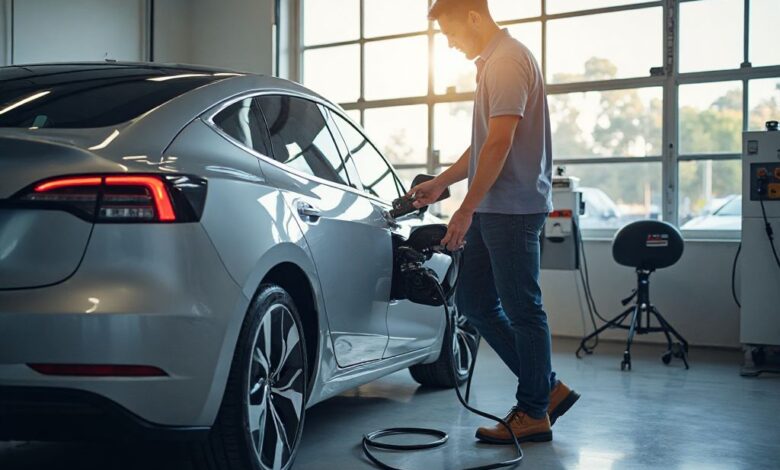
While the list of eliminations is long, EVs still require some basic maintenance, albeit at far less frequent intervals and often with simpler procedures.
- Brakes: This is where regenerative braking truly shines. EVs use their electric motors to slow down, converting kinetic energy back into electricity and recharging the battery. This means the friction brakes (pads and rotors) are used far less frequently and less aggressively than in an ICE car. Owners often report brake pads lasting 70,000, 100,000 miles, or even longer. While they still need to be inspected and occasionally serviced (e.g., to prevent rust on unused surfaces), replacement is a rare event.
- Tires: EVs are generally heavier than comparable ICE vehicles due to their battery packs, and their instant torque can lead to faster tire wear if driven aggressively. Regular tire rotations, balancing, and alignment are just as important, if not more so, for an EV. Choosing EV-specific tires (often marked “XL” for extra load or with low rolling resistance) can help mitigate this.
- Cabin Air Filter: Just like any other modern car, EVs have a cabin air filter to keep the interior air clean. This typically needs replacement every 15,000-30,000 miles, a simple and inexpensive task.
- Coolant: While there’s no engine coolant, EVs do have thermal management systems for their battery packs and electric motors. These systems use specialized coolants that typically have very long service intervals – often 100,000 miles or more, or even “lifetime” fills for some components.
- Wiper Blades and Washer Fluid: These remain universal automotive consumables.
- 12V Battery: EVs still use a traditional 12V battery to power accessories and start the high-voltage system. Like in an ICE car, this battery will eventually need replacement, typically every 3-5 years.
- Software Updates: Many EVs, particularly those from Tesla, Ford (with their Power-Up updates), Hyundai, and Kia, receive over-the-air (OTA) software updates. These updates can improve performance, add new features, fix bugs, and even enhance battery efficiency without a visit to the dealership. This isn’t maintenance in the traditional sense, but it’s a vital part of keeping your EV optimized.
Why It Costs Less: The Financial Impact
When you combine the elimination of numerous high-frequency, high-cost maintenance items with the extended life of components like brakes, the financial savings become undeniable. A study by AAA found that EV maintenance costs are, on average, 50% less than those for gasoline-powered cars. Other analyses show even greater savings over time. Fewer parts mean less labor, fewer consumables, and ultimately, a much lighter wallet impact for the owner. For instance, a basic oil change and tire rotation for an ICE vehicle might cost $80-$150 annually. An EV might only need a tire rotation and general inspection for $50-$100 every 10,000 miles. Over 5-10 years, these savings compound significantly.
Expert Analysis: Beyond the Basics
As an automotive journalist who’s seen the industry evolve rapidly, I can offer a few insider insights that go beyond the spec sheet:
- Battery Warranty is Your Peace of Mind: The biggest perceived maintenance “threat” for EVs is battery replacement. However, virtually all EV manufacturers – from Chevrolet to Audi, Porsche, and Lucid – offer extensive battery warranties, typically 8 years or 100,000 miles, and often longer (e.g., Tesla offers 8 years/120,000 miles for Model S/X). This means that for the vast majority of owners, battery degradation or failure within the typical ownership period is covered, making this a non-issue for TCO. Modern batteries are incredibly robust and designed to outlast the vehicle itself.
- The Rise of Software-Defined Vehicles (SDV) Reduces Dealership Visits: Brands like Tesla pioneered this, but now Ford (with its F-150 Lightning and Mustang Mach-E), Rivian, and even Volkswagen are embracing OTA updates. These updates can remotely diagnose issues, apply fixes, and even prevent problems before they arise, reducing the need for costly diagnostic visits to the service center. It’s like your car gets smarter and healthier while you sleep.
- Specialized Technicians, Less Frequent Need: While EVs require less maintenance, when they do need specialized attention (e.g., high-voltage system diagnostics), it requires highly trained technicians. This is an investment dealerships are making. However, the infrequency of these complex repairs means you’re still coming out ahead. It’s not that EV repairs are inherently cheaper; it’s that they are far, far less common.
- Resale Value Boost from Lower TCO: As the market matures, the lower maintenance costs of EVs will increasingly factor into their resale value. A used EV with a proven track record of minimal service requirements will be more attractive to a second owner than a comparable ICE vehicle facing potential major service intervals (timing belt, transmission flush) in its future. This bolsters the long-term financial argument for EVs.
- The “Hidden” Cost of ICE: Many ICE owners only consider their annual oil change. They often forget the cumulative costs of spark plugs, fuel filters, serpentine belts, coolant flushes, transmission services, and the eventual big-ticket items like exhaust system repairs or catalytic converter replacements. Over 100,000 miles, these can easily run into thousands of dollars, costs largely absent from the EV ownership experience.
The Electric Lineup: Brands Leading the Charge in Low Maintenance
Virtually every brand transitioning to EVs inherently benefits from the simplified maintenance schedule, but some stand out:
- Tesla: Known for minimalist design and reliance on OTA updates, Tesla vehicles often require very little traditional maintenance beyond tires, wipers, and cabin filters. Their direct-to-consumer service model also streamlines the process.
- Ford: With the Mustang Mach-E and the incredibly popular F-150 Lightning, Ford is demonstrating that even rugged, high-performance EVs enjoy the same maintenance benefits. Their “FordPass Power-Up” OTA updates keep vehicles current without dealership visits.
- Hyundai & Kia: These brands offer some of the industry’s best warranties (10 years/100,000 miles on powertrain and battery components), providing exceptional peace of mind for EV buyers, further reducing long-term cost anxiety. Their Ioniq 5 and EV6 models are examples of robust, low-maintenance EVs.
- Rivian: As an adventure-focused brand with the R1T and R1S, Rivian’s vehicles are built for durability. The inherent simplicity of the electric powertrain means less to go wrong, even when tackling rough terrain.
- Luxury Brands (BMW, Mercedes-Benz, Audi, Porsche, Lucid): While the initial purchase price of an iX, EQS, e-tron, Taycan, or Air might be higher, these luxury EVs still benefit from significantly reduced running costs in terms of maintenance compared to their ICE counterparts. This enhances the premium ownership experience by removing the hassle and expense of frequent service.
- Chevrolet & Volkswagen: Offering more accessible EVs like the Bolt EV/EUV and ID.4, these brands make the low-maintenance advantage available to a broader market, proving that affordability doesn’t mean sacrificing reliability or ease of ownership.
Pros and Cons of EV Maintenance
Pros:
- Significantly lower scheduled maintenance costs compared to ICE vehicles.
- Fewer moving parts mean fewer components to fail or replace.
- Extended brake life due to regenerative braking.
- No need for oil changes, spark plugs, fuel filters, or exhaust system repairs.
- Quieter operation contributes to less wear on some interior and suspension components.
- Over-the-air software updates can improve performance and fix issues remotely.
- Long battery warranties provide excellent peace of mind for major component longevity.
Cons:
- Potentially higher tire wear due to instant torque and vehicle weight (mitigated by proper tire choice and driving habits).
- Specialized tools and training are required for complex, high-voltage system repairs (though these are rare).
- While rare and covered by warranty, out-of-warranty battery replacement can be expensive (though very few vehicles ever reach this point).
- Some dealerships may still be catching up on EV service expertise and infrastructure.
The Future is Electric, and Economical: Your Next Car Decision
The narrative around electric vehicles is often dominated by range figures, charging times, and environmental impact. While these are undoubtedly crucial factors, the unsung hero of EV ownership is the profound simplicity and cost-effectiveness of their maintenance. We’ve established that the shift from complex internal combustion engines to elegant electric powertrains slashes recurring service costs, extends component life, and frees owners from the routine rituals of traditional car care.
For first-time EV buyers, this guide should