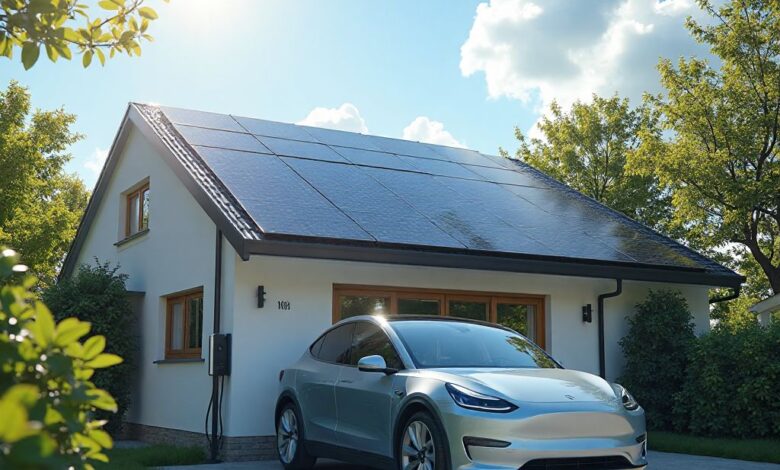
The Solar-Powered Commute: How Your EV and Rooftop Can Liberate You from Energy Bills
What if I told you that the sun, not the gas pump or even the utility company, could power your daily commute and significantly slash your household energy bills? It sounds like a futuristic dream, but for a growing number of savvy homeowners and car enthusiasts, this vision is becoming a tangible reality. The convergence of electric vehicles (EVs) and residential solar panels isn’t just a trend; it’s a powerful financial and environmental revolution happening right on our driveways and rooftops.
A Perfect Storm: Why Solar + EV Matters Now More Than Ever
For years, the promise of electric vehicles felt just out of reach for many, hampered by range anxiety, charging infrastructure concerns, and perceived high costs. Simultaneously, solar panels, while celebrated for their environmental benefits, often carried a hefty upfront price tag. Fast forward to today, and the landscape has dramatically shifted. We’re witnessing an unprecedented surge in EV adoption, with models from every major manufacturer – from the accessible Chevrolet Bolt to the luxurious Lucid Air, the practical Hyundai Ioniq 5 to the rugged Rivian R1T – offering compelling alternatives to gasoline cars. Concurrently, solar technology has matured, becoming more efficient and affordable, with government incentives often sweetening the deal.
But the true magic happens when these two technologies aren’t just adopted in isolation but are actively integrated. With volatile fuel prices and rising electricity rates, the incentive to generate your own power and use it to fuel your transportation has never been stronger. This isn’t just about being “green”; it’s about achieving a level of energy independence and financial predictability that was once unimaginable for the average household. For both first-time EV buyers and experienced car owners looking to optimize their energy consumption, understanding this synergy is paramount to unlocking substantial savings and future-proofing their energy strategy.
The Dynamic Duo: How Solar Panels and EVs Drive Down Your Bills
The Powerhouse on Your Roof: Solar Panels Explained
At its core, a residential solar panel system is elegantly simple. Photovoltaic (PV) cells, typically mounted on your roof, capture sunlight and convert it directly into direct current (DC) electricity. An inverter then transforms this DC power into alternating current (AC) electricity, which is the standard used by your home appliances and, crucially, your EV charger. Modern solar systems are robust, require minimal maintenance, and are designed to seamlessly integrate with your existing electrical infrastructure.
The Electric Steed in Your Garage: EVs and Their Thirst
Electric vehicles, from the pioneering Tesla Model S to the family-friendly Volkswagen ID.4, are essentially large batteries on wheels. They consume electricity to propel themselves, and this energy is typically replenished by plugging into a charging station. While public fast chargers offer convenience on the go, the vast majority of EV charging happens at home, overnight. A Level 2 (240V) charger, common in most homes, can fully charge an EV like a Ford Mustang Mach-E or a Kia EV6 in 6-10 hours, depending on battery size. This home charging represents a significant portion of a household’s electricity consumption, making it a prime target for solar offset.
Synergy in Action: How Solar Fuels Your EV
The most straightforward way solar and EVs work together is direct charging. When your solar panels are generating electricity during the day, that power can be used immediately to charge your EV. If your car is plugged in while the sun is shining, you’re essentially fueling up for free, directly from your roof. Even if you primarily charge overnight, solar panels still play a crucial role through a concept called “net metering.”
With net metering, any excess electricity your solar panels generate during the day (when your EV might not be plugged in, or your home consumption is low) is sent back to the utility grid. Your utility company then credits your account for this power. When you charge your EV at night, or at any time when your home needs more electricity than your panels are producing, you draw power from the grid. Thanks to the credits you’ve accumulated, your overall electricity bill is significantly reduced, often to zero, effectively making your nighttime EV charging “solar-powered.”
Beyond Charging: The Smart Home Energy Ecosystem
The true genius of the solar-EV partnership extends beyond simple charging. Integrating home battery storage systems, such as the Tesla Powerwall or Enphase Encharge, allows you to store excess solar energy generated during the day for use at night, further reducing reliance on the grid and providing backup power during outages. This battery can power your home and your EV, creating a truly self-sufficient energy ecosystem.
But the most exciting frontier is Vehicle-to-Home (V2H) and Vehicle-to-Grid (V2G) technology. Imagine your EV not just as a consumer of energy but as a mobile power bank for your home or even the grid. The Ford F-150 Lightning, for instance, with its Pro Power Onboard and available Ford Intelligent Backup Power system, can power an entire home for days during an outage, turning your truck into a massive, mobile battery storage unit. Similarly, models like the Hyundai Ioniq 5 and Kia EV6 offer Vehicle-to-Load (V2L) capabilities, allowing you to power external appliances, a stepping stone to full V2H functionality.
V2G takes this a step further, enabling your EV to send excess stored energy back to the grid during peak demand times, potentially earning you money from your utility company. While V2G is still in its nascent stages, requiring specific chargers and utility agreements, it represents the ultimate fusion of transportation and energy management, turning your EV into an active participant in stabilizing the grid and maximizing your solar investment.
The Bottom Line: Realizing Financial Freedom
The financial benefits are compelling. By generating your own electricity for your home and EV, you virtually eliminate gasoline costs and drastically reduce, if not erase, your monthly electricity bill. Consider the average driver who spends hundreds, if not thousands, annually on fuel. With solar-powered charging, that expense disappears. While the upfront cost of solar panels and an EV can be substantial, government incentives (like the federal solar tax credit and EV tax credits), coupled with long-term savings, often lead to a favorable return on investment. Over the lifespan of your solar system (25+ years) and your EV, the cumulative savings can amount to tens of thousands of dollars, making it one of the smartest financial decisions a homeowner can make today.
Expert Analysis: Insider Insights for the Savvy Prosumer
- The “Prosumer” Revolution is Here: You’re no longer just a consumer of energy; you’re a producer. This shift empowers you, giving you control over your energy destiny. Understanding this fundamental change in your relationship with energy providers is key. It’s about resilience, independence, and taking an active role in the energy transition.
- Smart Energy Management is Non-Negotiable: Simply having solar and an EV isn’t enough; you need smart energy management. This involves smart home hubs, intelligent EV chargers (like those from Wallbox or ChargePoint), and apps that allow you to monitor production, consumption, and even schedule charging during off-peak hours or when solar production is highest. Optimizing these systems is where the deepest savings lie.
- Bidirectional Charging: The Game Changer for Grid Stability: While V2H/V2G is still evolving, its potential impact on the national grid is immense. Imagine thousands of EVs acting as distributed energy storage units, absorbing excess renewable energy (from solar and wind) and discharging it back during peak demand. This could fundamentally transform grid stability, reduce the need for fossil fuel peaker plants, and accelerate the transition to 100% renewables. Keep an eye on regulatory developments and utility programs in this space.
- Navigating the Incentive Labyrinth: Federal, state, and local incentives for both solar and EVs are constantly changing. From federal tax credits to state rebates and local property tax exemptions, the landscape can be complex. Don’t go it alone; consult with reputable solar installers and EV dealerships who are well-versed in the latest programs to maximize your financial benefits.
- Beyond Dollars: The Value of Resilience and Peace of Mind: While financial savings are a powerful motivator, the intangible benefits are equally compelling. Knowing your home and car are powered by clean, self-generated energy offers immense peace of mind. During power outages, a solar-plus-battery system (with V2H capability from an EV like the Ford F-150 Lightning) can keep your lights on and essentials running, providing a critical layer of resilience that traditional homes lack. This independence from grid fluctuations and external events is a value that’s hard to put a price on.
Pros and Cons of the Solar + EV Ecosystem
Pros:
- Significant Cost Savings: Eliminate or drastically reduce gasoline and electricity bills.
- Environmental Benefits: Zero tailpipe emissions and reduced carbon footprint for your home and transportation.
- Energy Independence: Less reliance on the utility grid and fluctuating energy prices.
- Increased Home Value: Solar panels are a proven asset that boosts property value.
- Grid Resilience: Home battery storage and V2H-capable EVs provide backup power during outages.
- Government Incentives: Access to federal, state, and local tax credits and rebates.
- Quiet Operation: Enjoy the serene experience of a solar-powered EV.
Cons:
- High Upfront Cost: Initial investment for solar panels, EV, and home battery can be substantial.
- Roof Suitability: Not all roofs are ideal for solar panel installation (angle, shading, age).
- Weather Dependency: Solar production varies with sunlight availability (clouds, night).
- Installation Complexity: Requires professional installation and potential electrical upgrades.
- Varying Grid Policies: Net metering and V2G policies differ significantly by region and utility.
- EV Battery Degradation: While slow, EV batteries do degrade over time, impacting range and V2H capacity.
Final Verdict: Embrace the Future of Sustainable Mobility and Living
The combination of solar panels and electric vehicles isn’t merely a niche interest for environmentalists; it’s a pragmatic, financially astute strategy for anyone looking to take control of their energy future. From the cutting-edge bidirectional charging capabilities of a Ford F-150 Lightning to the seamless integration of a Tesla Model 3 with a Powerwall, the technology is here, and it’s getting smarter and more accessible every day. While the initial investment requires careful consideration, the long-term financial savings, environmental stewardship, and unparalleled energy independence make it an undeniably compelling proposition.
My recommendation is clear: if you’re considering an EV, or already own one, it’s time to seriously explore residential solar. And if you’re contemplating solar, factor in an EV as the ultimate complement to maximize your investment. The future of sustainable mobility and living isn’t just arriving; it’s powered by the sun and charged in your garage. Start researching your options today, consult with experts, and prepare to drive into a future where your energy bills become a distant memory.