The Biggest Myths About Electric Vehicles That Need to Stop
Picture this: a car that accelerates faster than most sports sedans, costs pennies to “fuel,” and emits zero tailpipe emissions. Sounds like science fiction, right? Well, it’s not. It’s the reality of today’s electric vehicles (EVs), and they’re already outselling expectations globally. Yet, despite their surging popularity and undeniable advancements, the automotive world remains plagued by persistent myths about EVs – outdated notions that prevent countless drivers from experiencing a truly revolutionary way to commute. It’s time to set the record straight, once and for all.
Why We Need to Bust These Myths Now
The transition to electric mobility isn’t just a trend; it’s a pivotal shift in the automotive landscape, driven by technological innovation, environmental necessity, and evolving consumer demands. For car buyers and enthusiasts today, understanding EVs is no longer optional. With governments worldwide pushing for electrification, and manufacturers like Ford, GM, Volkswagen, and Mercedes-Benz investing billions into EV development, the internal combustion engine’s dominance is waning. Every day, more exciting models like the Ford F-150 Lightning, Kia EV6, Hyundai Ioniq 5, and Rivian R1T hit the market, offering compelling alternatives to traditional gasoline cars. However, lingering misinformation creates unnecessary apprehension, clouding judgment and potentially leading consumers to miss out on vehicles that could perfectly fit their lifestyle and budget. Our goal here is to equip you with the accurate, up-to-date information needed to make an informed decision, dispelling the fog of fiction with the light of fact.
Myth #1: EVs Have Terrible Range and Range Anxiety is a Deal-Breaker
This is perhaps the most enduring myth, a relic from the early days of EVs when 100-mile ranges were common. Today, that narrative is as outdated as flip phones. Modern EVs offer ranges that comfortably exceed the daily driving needs of most Americans. The average U.S. driver travels less than 40 miles a day. Consider vehicles like the Lucid Air Grand Touring, boasting an EPA-estimated range of over 500 miles, or the Tesla Model S Long Range, which easily surpasses 400 miles. Even more accessible models like the Hyundai Ioniq 6, Kia EV6, and Chevrolet Bolt EV offer well over 250 miles of range, making cross-state trips entirely feasible with minimal planning.
Range anxiety, while a legitimate concern for some in the past, has largely been mitigated by improved battery technology and a rapidly expanding charging infrastructure. Think of it this way: you don’t fret about finding a gas station on your typical commute, do you? Most EV owners charge at home overnight, waking up to a “full tank” every morning. For longer journeys, public charging networks are growing exponentially, with fast-charging stations capable of adding hundreds of miles of range in under 30 minutes. Brands like Electrify America, EVgo, and Tesla’s Supercharger network are constantly expanding, making long-distance travel increasingly seamless.
Myth #2: EVs Are Too Expensive and Out of Reach for the Average Buyer
While it’s true that some premium EVs, like the Porsche Taycan or Audi e-tron GT, carry luxury price tags, the market has rapidly diversified. The initial purchase price of an EV has indeed been a barrier for some, but prices are steadily decreasing, and a wealth of affordable options now exist. Vehicles like the Chevrolet Bolt EV and Nissan Leaf offer entry points well under $30,000 (before incentives). Furthermore, federal tax credits (up to $7,500 for eligible vehicles and buyers) and various state and local incentives can significantly reduce the effective purchase price, often bringing EVs into parity or even below comparable gasoline cars.
But the true cost story of an EV extends far beyond the sticker price. When you factor in the dramatically lower “fuel” costs (electricity is significantly cheaper per mile than gasoline, especially when charging at home), reduced maintenance needs (no oil changes, spark plugs, or complex exhaust systems), and potential tax benefits, the total cost of ownership (TCO) for an EV often beats that of a gasoline car over its lifespan. For example, a Ford F-150 Lightning owner will spend considerably less on energy to power their truck than a traditional F-150 owner spends on gasoline.
Myth #3: Charging Takes Forever and There Aren’t Enough Chargers
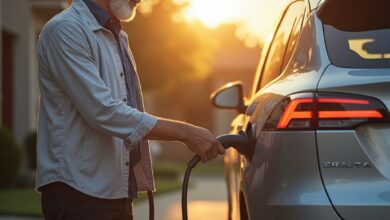
This myth often stems from a misunderstanding of how EV owners typically charge. Most charging happens at home, overnight, while you sleep. A Level 2 home charger (240V, like a clothes dryer outlet) can fully recharge most EVs in 6-10 hours, providing more than enough range for daily driving. This means you start every day with a full “tank,” a convenience gasoline car owners can only dream of.
For those times you need to charge on the go, the public charging infrastructure is booming. According to the U.S. Department of Energy, there are over 180,000 public charging ports across more than 50,000 stations in the U.S. – a number that grows daily. While it’s true that the density isn’t uniform everywhere, major corridors and urban centers are well-covered. More importantly, DC Fast Chargers (Level 3) can add 150-250 miles of range in just 20-40 minutes, depending on the vehicle and charger output. Think of it as a coffee break or a quick meal stop, not an all-day affair. And with brands like Tesla opening their Supercharger network to other EVs, and initiatives like the National EV Infrastructure (NEVI) program, the charging landscape is improving at an unprecedented pace.
Myth #4: EVs Aren’t Really Green Because of Battery Production and Electricity Sources
This is a more nuanced myth, often presented without full context. Yes, manufacturing EV batteries is energy-intensive and involves mining critical minerals. However, numerous studies, including those from the EPA and various academic institutions, consistently show that EVs have a significantly lower lifetime carbon footprint than comparable gasoline vehicles, even when accounting for battery production and the current electricity grid mix. As electricity grids become greener (with increasing shares of renewable energy like solar and wind), the environmental advantage of EVs only grows.
Furthermore, battery technology is rapidly advancing. Manufacturers are developing more sustainable mining practices, improving recycling processes for old batteries (recovering valuable materials like lithium, cobalt, and nickel), and exploring solid-state battery technology that could reduce reliance on certain materials. Brands like BMW and Volkswagen are heavily invested in ethical sourcing and closed-loop recycling programs. The notion that EVs simply shift pollution is a simplistic argument that ignores the full lifecycle analysis and the rapid innovations aimed at making EV production and disposal even more sustainable.
Myth #5: EVs Are Slow, Boring, or Unsafe
Anyone who believes EVs are slow has clearly never experienced the instant torque of a Tesla Model 3 Performance, a Rivian R1S, or a Porsche Taycan Turbo S. EVs deliver exhilarating acceleration that can pin you to your seat, often outperforming high-performance gasoline cars off the line. Their low center of gravity (due to the heavy battery pack mounted in the floor) also gives them exceptional handling and stability, making them incredibly engaging to drive.
As for safety, EVs are designed and tested to the same rigorous safety standards as gasoline vehicles. In fact, many EVs, like the Volvo EX90 or Mercedes-Benz EQE, consistently earn top safety ratings from organizations like the IIHS and NHTSA. The battery pack is heavily protected, and the absence of a large engine block in the front allows for larger crumple zones, potentially enhancing occupant protection in frontal collisions. While battery fires can occur, statistics show they are significantly less common than fires in gasoline vehicles.
Expert Analysis: Beyond the Headlines
- The Software-Defined Vehicle Advantage: Unlike gasoline cars, EVs are essentially computers on wheels. This means they can receive over-the-air (OTA) software updates, much like your smartphone. Tesla pioneered this, but now brands like Ford, GM, and Hyundai are following suit. These updates can improve range, boost performance, add new features, and even fix issues without a trip to the dealership. It means your EV can literally get better over time, a concept unheard of in the ICE world.
- Vehicle-to-Load (V2L) and Vehicle-to-Home (V2H) Capabilities: Modern EVs are not just transportation; they’re mobile power banks. Features like V2L, available on the Kia EV6 and Hyundai Ioniq 5, allow you to power external devices – from a coffee maker on a camping trip to tools on a job site. The Ford F-150 Lightning takes this further with V2H, capable of powering your entire home during a power outage for several days. This adds an incredible layer of utility and resilience that gasoline cars simply cannot match.
- The Rapid Evolution of Battery Chemistry: The “battery tech is stagnant” argument is pure fiction. Companies are constantly innovating, moving from Nickel-Manganese-Cobalt (NMC) to Lithium Iron Phosphate (LFP) for some models (like certain Tesla Model 3s) which offer greater durability and lower cost. Solid-state batteries, currently under development by Toyota, BMW, and others, promise even higher energy density, faster charging, and improved safety, with commercialization expected later this decade.
- Maintenance is Truly Simpler: Beyond the obvious lack of oil changes, consider the braking system. EVs primarily use regenerative braking, where the electric motor slows the car and converts kinetic energy back into electricity for the battery. This significantly reduces wear and tear on traditional friction brakes, meaning brake pads and rotors last far longer than in an ICE vehicle, saving you money and hassle.
- The “Tipping Point” is Already Here: While adoption rates vary, the global automotive industry has passed the critical “tipping point” for EV adoption. New EV sales are accelerating, manufacturing capacity is scaling, and the technology is proven. The question is no longer if EVs will take over, but how quickly. Early adopters are no longer the only ones buying; mainstream consumers are now making the switch, signaling a fundamental and irreversible shift.
Pros and Cons of Electric Vehicles
- Pros:
- Significantly lower running costs (cheaper “fuel” and less maintenance).
- Instant torque and exhilarating acceleration.
- Zero tailpipe emissions, contributing to cleaner air.
- Quieter, smoother, and more refined driving experience.
- Reduced reliance on fossil fuels.
- Eligibility for federal, state, and local incentives.
- Convenient home charging.
- Advanced technology, including OTA updates and V2L/V2H capabilities.
- Often boast cutting-edge interior design and technology (e.g., Lucid Air, Mercedes-Benz EQS).
- Cons:
- Higher upfront purchase price for some models (though decreasing).
- Public charging infrastructure, while growing, can still be inconsistent in some rural areas.
- Longer “refueling” times compared to gasoline cars on long trips (though fast charging is improving).
- Battery degradation over very long periods (though typically covered by long warranties).
- Weight of the battery pack impacts overall vehicle weight.
- Environmental impact of battery production and mineral extraction (though improving with recycling).
Final Verdict: The Future is Electric, and It’s Ready for You
The myths surrounding electric vehicles are crumbling under the weight of real-world experience and undeniable technological progress. EVs are no longer niche curiosities; they are high-performance, practical, and increasingly affordable machines that offer a superior driving experience and significant long-term savings. From the luxury of a BMW iX to the utility of a Ford F-150 Lightning, the efficiency of a Tesla Model 3, or the distinctive style of a Hyundai Ioniq 5, there’s an EV for nearly every need and budget.
My recommendation? Don’t let outdated myths dictate your next vehicle purchase. The best way to truly understand the EV revolution is to experience it for yourself. Go to your local dealership, schedule a test drive, and feel the instant torque, the quiet cabin, and the smooth ride. Talk to current EV owners. Research the incentives available in your area. The future of driving is here, and it’s time to stop believing the hype and start embracing the electric reality.