If you thought electric vehicles were already cool, buckle up. This year has seen more technological leaps in the EV world than in the entire last decade of gasoline car development.
The competition is no longer just about adding 10 miles of range; it’s about fundamentally changing how we store energy, how quickly we refill, and how our cars interact with the world. These breakthroughs are quickly turning science fiction into showroom reality.
Here are 15 Exciting Breakthroughs in EV Technology that are defining 2025:
I. Battery Revolution: More Energy, Less Time
The biggest area of innovation is still the battery, which is getting lighter, safer, and faster to fill.
1. Solid-State Batteries Enter Pilot Production
This is the holy grail. Unlike current batteries that use a liquid electrolyte (which can catch fire), solid-state batteries use a solid material.
- The Breakthrough: It promises up to 50% more range in the same size battery, much faster charging, and significantly lower fire risk. Toyota and Mercedes-Benz are among those pushing pilot programs toward mass production by the end of the decade.
2. The 800-Volt Architecture Standard
A few years ago, only high-end sports cars had 800-volt battery systems (like the Porsche Taycan).
- The Breakthrough: This year, more mainstream models (like the Hyundai IONIQ 5 and new BMW models) are adopting this standard. 800V allows for much higher charging speeds—think 10% to 80% charge in as little as 15-18 minutes.
3. LFP Batteries Go Mainstream and Affordable
Lithium Iron Phosphate (LFP) batteries are not new, but they used to be limited to short-range cars.
- The Breakthrough: Thanks to manufacturing improvements, LFP is now common in mid-range EVs. They are cheaper to produce, don’t require expensive cobalt, last longer (more charging cycles), and are helping drive down the overall cost of EVs globally.
4. Advanced Battery Preconditioning
EV drivers hate losing range in cold weather.
- The Breakthrough: New software uses Artificial Intelligence (AI) to learn your schedule and route. When you navigate to a fast charger, the car automatically adjusts the battery temperature to the perfect level for maximum charging speed before you even plug in.
5. Direct-to-Battery Recycling
The push for sustainability is leading to better recycling technology.
- The Breakthrough: New processes can recover over 90% of a battery’s valuable materials (like lithium and nickel) without complex and costly melting. This creates a sustainable “closed-loop” manufacturing system.
II. Charging and Energy Integration
It’s not just the car getting smarter, it’s the charging ecosystem too.
6. Widespread NACS Adoption
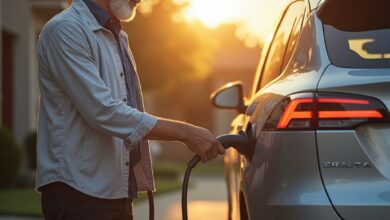
Tesla’s North American Charging Standard (NACS) charging port has been adopted by nearly all major automakers in the US.
- The Breakthrough: This massive standardization means that, soon, almost every EV will be able to plug directly into the fast, reliable Tesla Supercharger network, eliminating a huge source of “range anxiety” for millions of drivers.
7. Plug & Charge Simplicity
Remember struggling with charging apps and credit cards?
- The Breakthrough: More public charging stations are adopting the Plug & Charge standard (based on the ISO 15118 protocol). You simply plug the car in, and the car and charger communicate automatically to authenticate and pay for the charge. No apps needed.
8. V2G (Vehicle-to-Grid) Reality
Your EV is a huge battery on wheels. V2G allows it to give power back.
- The Breakthrough: New models like the Ford F-150 Lightning and several public bus fleets are integrating bidirectional charging. This means your car can power your house during a blackout or even sell energy back to the power grid during peak demand times.
9. Wireless Charging Pilot Programs
Forget plugs and cables completely.
- The Breakthrough: High-speed wireless charging pads are being tested in specific cities for commercial fleets and taxis. Drivers simply pull into a spot, and the vehicle begins charging through the magnetic pad embedded in the ground.
III. Vehicle Design and Software
The internal structure and smart features are also seeing massive upgrades.
10. Cell-to-Pack Integration
Traditional batteries use modules that hold groups of cells.
- The Breakthrough: Manufacturers are skipping the modules and packing cells directly into the battery housing (cell-to-pack). This simpler design saves space, reduces weight, and increases the battery’s energy density.
11. The Software-Defined Vehicle (SDV)
Your car is now a computer that drives.
- The Breakthrough: Automakers like BMW (with its Neue Klasse platform) are designing the entire car around a central software platform. This allows new features to be rolled out via Over-The-Air (OTA) software updates, improving the car’s performance and features over time, just like your smartphone.
12. “Tank Turn” and Off-Road EV Control
Electric motors offer unprecedented control over individual wheels.
- The Breakthrough: Vehicles like the Mercedes-Benz EQG and Rivian models use four-motor setups to allow the car to pivot on the spot (the “G-Turn” or “Tank Turn”), dramatically improving off-road capability and showing the unique advantages of electric power.
13. AI-Powered Predictive Maintenance
EVs use vast amounts of data from sensors.
- The Breakthrough: Advanced systems can now use AI to monitor battery cell health and motor efficiency in real-time. The system can alert the driver or service center to a potential issue weeks before it causes a problem, allowing for cheaper, quicker repairs.
14. Panoramic Digital Displays
The central screen is growing.
- The Breakthrough: The next generation of cars features “cinematic” dashboard screens that stretch from the driver’s side all the way to the passenger side, offering shared navigation, entertainment, and safety data in an entirely new format.
15. Eco-Conscious Interiors
Sustainability is moving beyond the tailpipe.
- The Breakthrough: New EVs are increasingly using sustainable materials in the cabin, including recycled ocean plastics, plant-based synthetic leathers, and fabrics made from recycled bottles. This reduces the car’s overall environmental footprint.
These breakthroughs show that the EV market is still in its early, most exciting phase. Every year brings us closer to a future where electric cars are not just an alternative, but the clearly superior choice.