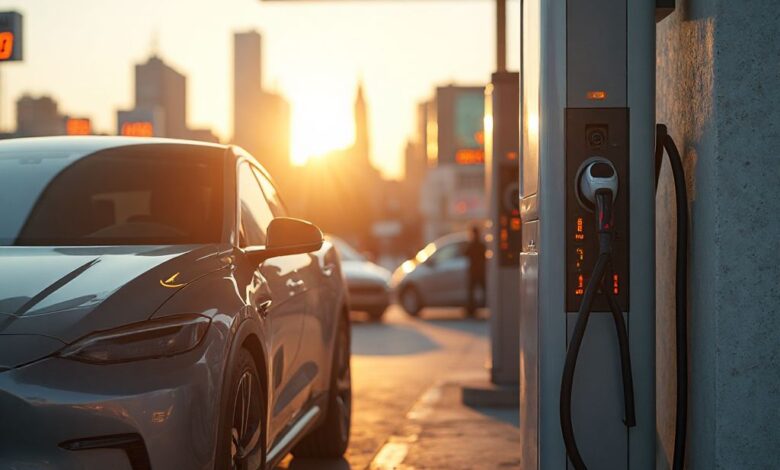
How Rising Gas Prices Are Accelerating the Switch to Electric Vehicles
Imagine a world where your daily commute costs pennies on the dollar compared to what you’re currently paying at the pump. A world where the sting of rising gas prices becomes a distant memory. Well, that future isn’t just on the horizon; it’s here, and it’s being driven by the very thing that’s been emptying our wallets: exorbitant fuel costs. Indeed, a recent analysis by AAA revealed that the national average for gasoline prices surged by over 50% in the last two years alone, a staggering increase that is pushing millions of drivers to seriously consider, and increasingly commit to, an electric vehicle (EV).
The Unavoidable Truth: Fuel Costs and Their Impact
For decades, the internal combustion engine (ICE) vehicle reigned supreme, fueled by relatively stable and affordable gasoline. But the past few years have shattered that illusion. Geopolitical events, supply chain disruptions, and shifting global demands have sent fuel prices spiraling, turning every fill-up into a painful reminder of our dependency on fossil fuels. This volatility isn’t just a temporary inconvenience; it’s a fundamental shift that is forcing car buyers and enthusiasts alike to re-evaluate their priorities. The question is no longer “if” EVs will become mainstream, but “how quickly,” and rising gas prices are undoubtedly hitting the accelerator on this transition.
This economic reality is particularly poignant for first-time buyers and families on a budget, for whom fuel efficiency has always been a key purchasing factor. Now, with the dramatic increase in gas prices, the long-term savings offered by an EV are no longer a niche consideration but a compelling financial imperative. Even for experienced car owners accustomed to the roar of a V8, the whisper-quiet efficiency of an EV is starting to sound incredibly appealing as they watch their fuel bills climb.
The Electric Revolution: Specs, Savings, and Serenity
The argument for electric vehicles has never been stronger, especially when viewed through the lens of your wallet. Let’s break down why.
The Financial Equation: Beyond the Sticker Price
It’s true that the upfront cost of many EVs can still be higher than their gasoline counterparts. However, this is a short-sighted view. The real savings come from the Total Cost of Ownership (TCO). When you factor in:
- Fuel Savings: This is the big one. Charging an EV at home, especially during off-peak hours, can be dramatically cheaper than buying gasoline. While electricity rates vary, even at peak times, the cost per mile is often a fraction of what you’d pay for gas. Imagine “filling up” your Ford F-150 Lightning for a fraction of what a traditional F-150 costs.
- Lower Maintenance: EVs have far fewer moving parts than ICE vehicles. No oil changes, no spark plug replacements, no transmission fluid flushes, and often less brake wear thanks to regenerative braking. This translates to significant savings over the lifetime of the vehicle.
- Government Incentives: Federal tax credits of up to $7,500 for eligible new EVs, coupled with various state and local rebates, can significantly reduce the purchase price, making a Tesla Model 3 or a Hyundai Ioniq 5 much more attainable.
Range Anxiety: A Fading Specter
One of the biggest historical hurdles for EV adoption has been “range anxiety.” But modern EVs have largely laid this fear to rest. Popular models like the Tesla Model Y, Ford Mustang Mach-E, and Hyundai Ioniq 5 regularly offer ranges exceeding 250-300 miles on a single charge. Luxury contenders like the Lucid Air Grand Touring push that well past 500 miles. For the average driver, who travels less than 40 miles a day, this is more than ample.
Furthermore, the charging infrastructure is rapidly expanding. Networks like Electrify America, EVgo, and Tesla’s Supercharger network are making long-distance travel increasingly viable. While a gas station fill-up is still faster than even the quickest DC fast charger, the convenience of waking up to a “full tank” every morning after charging at home (Level 2 charger) is a game-changer for daily commutes.
Performance and Driving Experience: A Silent Thrill
Beyond the financial and practical benefits, EVs offer a driving experience that often surpasses their gasoline rivals. The instant torque delivery means exhilarating acceleration from a standstill, whether you’re in a nimble Chevrolet Bolt EUV or a blistering Porsche Taycan. The silent operation and smooth, linear power delivery create a serene cabin environment, enhancing comfort and reducing driver fatigue. Brands like BMW with their i4 and Mercedes-Benz with the EQS are redefining luxury through electric propulsion, combining cutting-edge technology with unparalleled refinement.
Expert Analysis: Beyond the Headlines
As an automotive journalist who has seen the industry evolve over the last decade, I can offer some deeper insights into this accelerating shift:
- The “Tipping Point” Has Been Crossed: Gas prices aren’t just a factor anymore; they’re the primary catalyst pushing hesitant buyers over the edge. We’ve moved past early adopters; now, the mainstream is realizing the tangible financial benefits of going electric. This isn’t just about environmental consciousness; it’s about economic survival for many.
- Resale Value Reversal: Historically, EVs depreciated faster than ICE cars due to battery concerns and evolving technology. However, with sustained high gas prices, we’re seeing a fascinating reversal. Used EVs, especially those with good range and fast-charging capabilities like a used Audi e-tron or Volkswagen ID.4, are holding their value remarkably well, often outperforming comparable gasoline models. The market is beginning to price in the long-term fuel savings into a vehicle’s residual value.
- OEMs Are Doubling Down Faster: Traditional automakers like Toyota, Ford, and General Motors, who might have been more conservative in their EV rollout, are now aggressively accelerating their electrification plans. The demand spike driven by gas prices has validated their multi-billion dollar investments, prompting them to bring new models like the Chevrolet Silverado EV and Toyota bZ4X to market even quicker. This competitive landscape benefits consumers with more choices and better technology.
- The Rise of the “Second Car EV”: For many families, the first EV purchase is often a “second car” – a commuter vehicle or city runner. But with models like the Rivian R1T and Ford F-150 Lightning demonstrating electric capability for heavy-duty tasks, and luxury sedans like the Lucid Air offering extreme range, the EV is rapidly becoming capable of being the primary, do-it-all vehicle for many households.
- Charging Infrastructure: The Next Frontier: While charging networks are growing, the sheer volume of new EVs hitting the roads will undoubtedly strain existing infrastructure. This presents both a challenge and an enormous investment opportunity. Expect to see massive public and private sector collaboration to build out charging hubs, smart grid solutions, and even inductive charging roads in the coming years.
The Pros and Cons of Going Electric Now
Making the switch is a significant decision. Here’s a balanced view:
Pros:
- Massive Fuel Cost Savings: Dramatically lower operating costs compared to gasoline vehicles.
- Reduced Maintenance: Fewer moving parts mean less frequent and less expensive servicing.
- Government Incentives: Federal, state, and local tax credits and rebates can lower the purchase price.
- Superior Driving Experience: Instant torque, quiet operation, and smooth acceleration.
- Environmental Benefits: Zero tailpipe emissions contribute to cleaner air.
- Home Charging Convenience: Wake up to a “full tank” every morning.
- Advanced Technology: EVs often come packed with cutting-edge infotainment and driver-assist features.
Cons:
- Higher Upfront Cost: EVs can still be more expensive to purchase initially, though incentives help.
- Charging Time: Refueling an ICE car is faster than even the quickest DC fast charge.
- Public Charging Availability/Reliability: While improving, public charging infrastructure can still be spotty or experience issues in some areas.
- Range Anxiety (Diminishing): While ranges are ample for most, long road trips still require planning.
- Battery Replacement Cost: Though rare, battery pack replacement is extremely expensive out of warranty (but batteries are designed to last the life of the car).
- Dependency on Home Charging: Best experience requires a home charging setup, which may not be feasible for all apartment dwellers.
Final Verdict: Drive the Change, Don’t Just Watch It
The writing is on the wall, or perhaps more accurately, the numbers are on the gas station sign. Rising fuel prices are no longer just an inconvenience; they are a powerful, undeniable force accelerating the transition to electric vehicles. For the first time in automotive history, the financial argument for an EV is as compelling, if not more so, than the environmental one.
For both seasoned car enthusiasts and first-time buyers alike, now is a pivotal moment to seriously consider an electric vehicle. With an ever-growing array of models from Tesla, BMW, Mercedes, Rivian, Ford, Hyundai, Kia, Audi, Porsche, Volkswagen, Chevrolet, and Lucid, there’s an EV to suit almost every need, budget, and driving style. The technology is mature, the range is sufficient, and the charging infrastructure is expanding daily.
Don’t let soaring gas prices dictate your commute or your budget any longer. Take control. Research the incentives available, explore the models that excite you, and most importantly, schedule a test drive. Experience the silent power and the financial freedom an EV offers. The future of driving isn’t just arriving; it’s waiting for you to plug in and drive it.