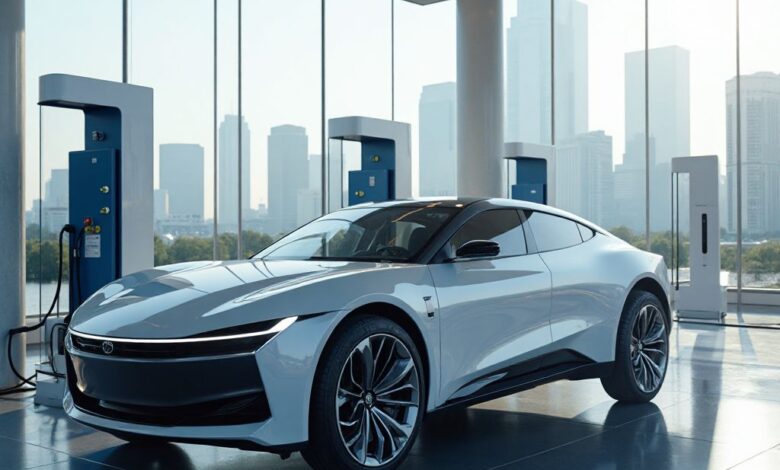
Imagine pulling into a station, and within the time it takes to order a coffee – or less – your electric car has a brand-new, fully charged battery. No waiting for 30, 40, or even 60 minutes. This isn’t a futuristic fantasy; it’s the everyday reality for Nio owners in China, and it represents one of the most audacious, capital-intensive challenges to Tesla’s charging dominance the electric vehicle (EV) world has ever seen. While Tesla has perfected the art of the fast charger, Nio is betting big on an entirely different philosophy: the rapid battery swap.
Background: The EV Charging Conundrum
For years, the twin specters of “range anxiety” and “charging time” have haunted potential EV buyers. While battery technology has advanced considerably, offering ranges comparable to gasoline cars, the act of refueling remains a sticking point. Tesla, with its ubiquitous and highly reliable Supercharger network, has done more than any other brand to mitigate these concerns. Their strategy has been clear: build a charging network so pervasive and efficient that range anxiety becomes a relic of the past. It’s a successful model, replicated to varying degrees by brands like Electrify America, Ionity, and even proprietary networks from Porsche and Mercedes.
But even the fastest DC fast chargers still require a significant chunk of time – typically 20-40 minutes to go from 10% to 80% state of charge. In a world where minutes matter, particularly in densely populated urban centers or during long-distance travel, this waiting period is a friction point. This is precisely the gap Nio aims to fill, not with faster charging, but with an entirely new paradigm for energy replenishment.
Nio’s Revolutionary Battery Swap Technology: The Power Swap Station
At the heart of Nio’s strategy is its Power Swap Station (PSS) network. These aren’t just charging points; they are fully automated robotic garages designed to remove a depleted battery from a Nio vehicle and replace it with a fully charged one in a matter of minutes. As an automotive journalist who’s witnessed countless innovations, I can tell you this is genuinely groundbreaking for the consumer experience.
How It Works: Seamless, Automated, Instant
The process is remarkably simple from the driver’s perspective. A Nio owner navigates to a PSS, often pre-booking a swap via the car’s infotainment system or the Nio app. Upon arrival, the car automatically parks itself precisely over an underground bay. The driver remains in the vehicle (or can step out), and the automated system takes over. Robotic arms swiftly unbolt the depleted battery pack from beneath the vehicle, extract it, and then slide a fresh, fully charged battery into its place. The entire operation typically takes less than three to five minutes – faster than a traditional gasoline fill-up. Once complete, the car guides itself out, and the driver is on their way with 100% range.
The Multifaceted Benefits for the Consumer
- Unmatched Speed and Convenience: This is the primary draw. No more waiting. No more wondering if a charger is available or operational. It’s a true “fill and go” experience.
- Elimination of Range Anxiety: With thousands of swap stations now operational across China and expanding into Europe, drivers know that a fresh battery is always just a short drive away, making long-distance travel as seamless as possible.
- Guaranteed Battery Health and Performance: Nio owns and manages the battery packs in its network. This means they are constantly monitored, optimally charged (often off-peak to reduce grid strain), and maintained. Owners always get a healthy, high-performing battery, free from the worries of individual battery degradation.
- Future-Proof Battery Upgrades: As battery technology evolves, Nio owners can seamlessly upgrade to newer, higher-capacity battery packs simply by swapping. This extends the usable life and appeal of their vehicle significantly.
- Lower Upfront Vehicle Cost (Battery as a Service – BaaS): Nio pioneered the “Battery as a Service” model. Customers can purchase a Nio vehicle without the battery, significantly reducing the initial purchase price. They then pay a monthly subscription fee for battery usage and access to the swap network. This makes premium Nio EVs more accessible financially.
- Reduced Grid Strain: Batteries at PSS locations can be charged during off-peak hours, acting as energy storage units and helping to balance the local power grid, a significant environmental and infrastructural advantage.
Nio’s Expanding Ecosystem and Vehicle Lineup
Nio isn’t just selling a technology; it’s selling a premium EV lifestyle. Their vehicle lineup – including the sleek ET5 and ET7 sedans, and the versatile ES6 and ES8 SUVs – are known for their luxurious interiors, cutting-edge technology, and strong performance. These vehicles are designed from the ground up to integrate seamlessly with the battery swap system. Beyond the cars and the PSS, Nio cultivates a strong community through its “Nio Houses,” premium spaces offering lounges, workspaces, and events for owners, further cementing a unique brand experience that few, if any, other automakers can match.
As of late 2023, Nio boasts over 2,400 Power Swap Stations in China, with ambitious plans to reach 4,000 by the end of 2025. This rapid expansion underscores their commitment and the significant investment they are making to build out this infrastructure.
Expert Analysis: Insider Insights on Nio’s Strategy
Having watched the automotive industry’s EV transition unfold for a decade, I can offer a few insider perspectives on Nio’s battery swap strategy:
- The “Holy Grail” of Standardization: The biggest hurdle to broader battery swap adoption has always been standardization. Historically, every automaker designs its battery pack differently. However, Nio is actively forging partnerships. Recently, major Chinese automakers like Changan, Geely, JAC, Chery, and Lotus have announced collaborations with Nio to adopt its battery swap standard. This is a monumental shift. If Nio can become the de facto standard for battery swapping, it fundamentally alters the competitive landscape, providing a powerful alternative to Tesla’s charging dominance.
- Beyond China: Scalability and Global Ambition: While China’s unique market conditions and strong government support have fostered Nio’s growth, the brand is now expanding into Europe (Norway, Germany, Sweden, Netherlands, Denmark). The challenge here is immense, as they face established charging networks and different regulatory environments. Their success in Europe will be a true test of the global viability of battery swapping.
- Data-Driven Battery Management: Nio’s ownership of the battery fleet provides an unparalleled advantage in data collection. They can monitor the health and performance of thousands of batteries in real-time, optimizing charging cycles, identifying potential issues before they impact owners, and maximizing the lifespan of their assets. This level of fleet management is simply not possible when individual owners are responsible for their own battery’s charging habits.
- The Tesla Conundrum: It’s worth remembering that Tesla itself experimented with battery swapping around 2013-2015 but ultimately abandoned it, citing high costs, complexity, and a lack of customer interest. Nio has learned from these early challenges. Tesla’s attempt was perhaps ahead of its time, lacked true automation, and came before the significant government backing Nio now enjoys in China. Nio’s fully automated, integrated approach, coupled with BaaS, addresses many of Tesla’s initial pain points.
- Government Endorsement: The Chinese government actively supports battery swapping technology, viewing it as a solution for grid stability, urban congestion, and promoting EV adoption. This policy backing provides Nio with a significant strategic advantage in its home market, offering subsidies and regulatory pathways that would be harder to replicate elsewhere.
Brand Comparisons: A Different Philosophy
When we compare Nio’s approach to other major players, the contrast is stark. Tesla’s Supercharger network is a marvel of engineering and deployment, providing rapid charging that has set the industry benchmark. For brands like BMW, Mercedes-Benz, Audi, Porsche, Ford, Hyundai, Kia, Rivian, Lucid, Volkswagen, Chevrolet, and Toyota, the primary focus remains on improving charging speeds and expanding access to public and home charging solutions. They are all working within the established paradigm of plugging in and waiting.
Nio, however, offers a fundamentally different ownership experience. It’s not about making charging faster; it’s about making “refueling” instantaneous. While Tesla’s network is undeniably vast and efficient, the act of waiting, even for 15-20 minutes, is still a wait. Nio eliminates that wait entirely, which for a segment of the market that values time above all else, is an incredibly powerful differentiator.
Pros and Cons of Nio’s Battery Swap Technology
Pros:
- Instantaneous “recharge” in under 5 minutes.
- Effectively eliminates range anxiety and charging wait times.
- Guaranteed battery health and optimal performance through Nio’s management.
- Future-proof design allows for battery upgrades as technology improves.
- Lower initial vehicle purchase price through the Battery as a Service (BaaS) model.
- Reduced stress on the power grid by allowing off-peak battery charging.
- Potential for battery reuse in second-life applications (energy storage).
Cons:
- High initial infrastructure cost for building Power Swap Stations.
- Requires vehicle-specific design, limiting compatibility to Nio vehicles (though partnerships are changing this).
- Network availability is