

Canoo Lifestyle Vehicle Review: The Strangest and Most Interesting EV Yet
Prepare to have your perception of what an electric vehicle “should” look like utterly shattered. Forget sleek sedans, rugged trucks, or even conventional crossovers. The Canoo Lifestyle Vehicle (LV) doesn’t just push the envelope; it folds it into a paper airplane and launches it into a completely different dimension. This isn’t just another EV; it’s a rolling statement, a minimalist marvel, and quite possibly, the most intriguing electric machine to emerge from the startup scene in years.
Background and Context: Redefining the Wheels We Live With
In an automotive landscape increasingly dominated by electric vehicles, the race for market share often boils down to range, charging speed, and raw horsepower. Yet, amidst this electrification frenzy, a deeper question is emerging: are we truly innovating, or merely electrifying existing paradigms? This is where the Canoo Lifestyle Vehicle enters the conversation with a resounding, albeit silent, declaration. It matters because it dares to ask: what if a vehicle was designed not just for driving, but for living?
For car buyers and enthusiasts today, the Canoo LV represents a pivotal moment. It challenges the very definition of a “car,” offering a cab-forward, lounge-like space that prioritizes utility, interior volume, and a unique user experience over traditional automotive aesthetics or performance metrics. In an era where urban congestion is a reality and multi-purpose functionality is highly prized, a vehicle that blurs the lines between personal transport, mobile office, and social hub holds immense relevance. It’s a bold departure from the conventional, forcing us to reconsider the role our vehicles play in our daily lives, particularly as we transition to an electric future that promises more than just zero emissions.
Main Content: A Deep Dive into Canoo’s Unconventional Charm
Design: Form Follows Function, and Future
The first glance at the Canoo Lifestyle Vehicle elicits a universal reaction: “What IS that?” It’s a question the designers at Canoo clearly revel in. Eschewing the long hood and aggressive stance of most modern vehicles, the LV adopts a “lofty,” cab-forward design that maximizes interior space within a surprisingly compact footprint. Think of it as a futuristic, minimalist interpretation of a classic microbus, but with a decidedly modern, almost appliance-like purity.
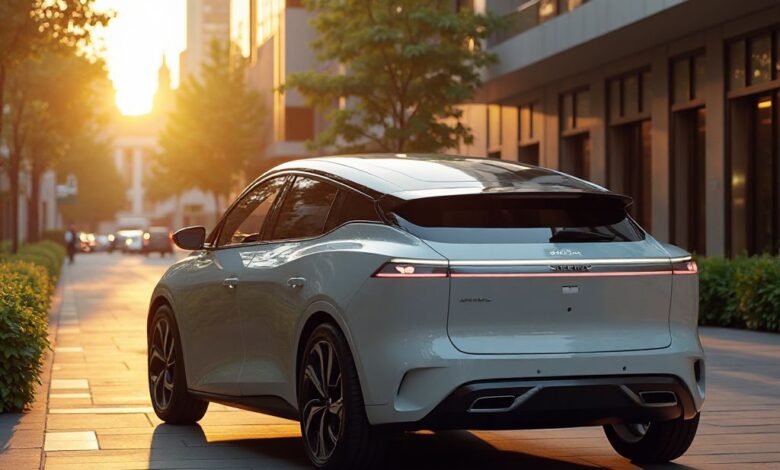
The exterior is dominated by smooth, uncluttered surfaces, large glass areas, and a distinct lack of traditional ornamentation. Its rounded edges and prominent wheel arches give it a friendly, approachable demeanor, while the full-width LED light bars front and rear provide a signature, high-tech touch. The most striking features are arguably the side doors, which open wide like barn doors, revealing an expansive, unobstructed entry to the cabin. This isn’t just for show; it’s a deliberate design choice aimed at enhancing accessibility and the vehicle’s inherent modularity. It’s a design that will undoubtedly polarize, but one that undeniably stands out in a sea of increasingly similar EVs. While a Tesla Cybertruck grabs attention with its sharp angles, the Canoo LV does so with its almost cartoonish yet utterly practical form.
Performance: Quiet Confidence, Urban Agility
While the Canoo LV won’t be setting any Nürburgring lap records, its performance is perfectly tailored to its intended purpose: efficient, comfortable urban and suburban mobility. Built on a proprietary “skateboard” platform that houses the battery and electric motors, the LV boasts a low center of gravity, contributing to stable handling and a surprisingly composed ride.
The base rear-wheel-drive model is expected to deliver around 300 horsepower and 332 lb-ft of torque, providing brisk acceleration that’s more than adequate for navigating city streets and merging onto highways. An all-wheel-drive option, likely with dual motors, would push output even higher, offering enhanced traction and potentially quicker sprints. While official 0-60 mph times haven’t been the focus, expect figures in the mid-6-second range, which is plenty quick for a vehicle focused on utility. The steer-by-wire technology, if it makes it to production, promises precise steering input and further enhances maneuverability, making tight parking spots and crowded urban environments less daunting than in larger traditional vehicles like a Ford F-150 Lightning or even a Rivian R1S.
Interior: A Lounge on Wheels
Step inside the Canoo Lifestyle Vehicle, and any preconceived notions of a car interior vanish. This is where the LV truly shines. The design ethos is one of ultimate spaciousness and modularity, creating an environment more akin to a modern living room than a conventional vehicle cabin. The cab-forward design means there’s no intrusive engine bay, allowing for an expansive, unobstructed floorplan.
Seating is revolutionary, with front occupants getting a bench seat that stretches across the width of the vehicle, offering a panoramic view through the enormous windshield. Rear passengers are treated to a lounge-style U-shaped bench, encouraging conversation and interaction. Storage is ingeniously integrated throughout, from under-seat compartments to cleverly designed bins and shelves. The minimalist dashboard features a small driver display and a larger central touchscreen for infotainment, but the overall impression is one of clean lines and uncluttered space. The sheer volume inside, especially considering its exterior dimensions, makes even spacious crossovers like the Hyundai Ioniq 5 or Kia EV6 feel somewhat constrained by comparison. It’s a blank canvas for customization, whether for personal use, ride-sharing, or commercial applications.
Technology: Smart Simplicity
Canoo’s technological approach is characterized by smart simplicity and a focus on core functionality. The aforementioned skateboard platform is the heart of it all, designed to be highly adaptable and scalable for various vehicle types. This modularity is a key differentiator, allowing for efficient manufacturing and diverse applications.
Infotainment is handled through a central touchscreen, expected to offer seamless smartphone integration (Apple CarPlay and Android Auto) and essential vehicle controls. Given Canoo’s emphasis on utility, expect robust connectivity options and over-the-air (OTA) update capabilities, ensuring the vehicle’s software remains current and new features can be added remotely. Driver-assist systems will likely include standard features like adaptive cruise control, lane-keeping assist, and automatic emergency braking, bringing it in line with modern safety expectations from brands like Volkswagen or Chevrolet. The focus isn’t on flashy, bleeding-edge tech for its own sake, but rather on integrated, intuitive solutions that enhance the user experience without overwhelming it.
Value for Money: A New Equation
Assessing the Canoo LV’s value for money is complex, given its unconventional nature and the company’s evolving business model. Initial pricing targets suggested a starting point in the mid-$30,000s, which, if achieved, would make it remarkably competitive for an EV offering such unique utility and space. However, like many EV startups, production challenges and market fluctuations have made firm pricing and availability a moving target.
Its value proposition lies not in direct head-to-head comparisons with a Tesla Model 3 or a BMW i4, but rather in its ability to serve multiple roles. For urban dwellers needing maximum interior space and maneuverability, or for businesses seeking a highly adaptable last-mile delivery solution, the LV could offer significant long-term value. Its potential for a lower total cost of ownership (TCO) due to electric propulsion and fewer moving parts also contributes to its financial appeal. It’s an investment in a different kind of mobility, one that prioritizes versatility and spatial efficiency over traditional automotive metrics.
Expert Analysis: Beyond the Buzz
1. The True Potential of the Skateboard Platform: While many EVs leverage a skateboard architecture, Canoo’s commitment to a truly minimalist, cab-forward design maximizes its utility. This isn’t just about packaging; it’s about fundamentally rethinking vehicle architecture. The platform’s modularity could become a template for future urban mobility solutions, potentially licensed to other companies or adapted for entirely new vehicle categories beyond what we currently imagine. It’s a foundational shift, not just an engineering convenience.
2. Market Acceptance vs. Radical Design: The biggest hurdle for Canoo isn’t just production, but public perception. Mainstream buyers, accustomed to decades of traditional car design, might find the LV’s aesthetics too polarizing. This isn’t a sleek Audi e-tron GT or a luxurious Mercedes-Benz EQS. Canoo needs to cultivate a specific niche of early adopters and forward-thinking commercial clients who prioritize functionality and unique design over conventional appeal. Their success will be a test case for how far consumers are willing to embrace truly unconventional automotive forms.
3. Urban Mobility Game Changer: The Canoo LV is perfectly positioned for the evolving landscape of urban mobility. Its compact footprint, exceptional interior volume, and potential for car-sharing or ride-hailing configurations make it an ideal candidate for dense city environments. It could reduce congestion by maximizing passenger or cargo capacity per vehicle, offering a compelling alternative to larger, less efficient vehicles for last-mile delivery or multi-passenger transport services. Think beyond personal ownership; envision fleets of Canoo LVs transforming city logistics.
4. The “Software-Defined Vehicle” in a Different Light: While Tesla pioneered the software-defined vehicle with OTA updates and feature unlocks, Canoo’s approach brings it to a utilitarian, multi-purpose platform. The ability to adapt the vehicle’s functions and features via software, combined with its modular hardware, means the LV can evolve over its lifespan in ways traditional vehicles simply cannot. This long-term adaptability is a silent strength, offering sustained relevance and potential for new revenue streams through subscription services or feature upgrades.
5. Startup Resilience and the Road Ahead: Canoo’s journey has been a rollercoaster, marked by leadership changes, financial challenges, and shifting strategies. This isn’t uncommon for ambitious EV startups, but it underscores the immense difficulty of bringing a truly innovative product to market. Their ability to secure government contracts (e.g., NASA, USPS) and form strategic partnerships will be crucial. Unlike established giants like Ford or Toyota who can absorb initial losses on new EV ventures, Canoo’s survival hinges on executing its vision flawlessly and securing consistent funding.
Pros and Cons
- Pros:
- Radically unique, space-maximizing design
- Exceptional interior volume and modularity for its footprint
- Lounge-like, comfortable cabin experience
- Urban-friendly maneuverability and quiet EV operation
- Versatile platform for various personal and commercial uses
- Potential for lower total cost of ownership (TCO)
- Cons:
- Unconventional aesthetics will not appeal to everyone
- Unproven track record and fluctuating business model for a startup
- Limited availability and uncertain delivery timelines
- Potential lack of traditional dealership support/service network
- Range and charging infrastructure might not be as extensive as established players (e.g., Chevrolet Bolt, Volkswagen ID.4)
- Price point remains somewhat fluid and could be a barrier for some
Final Verdict: A Vision of Future Mobility
The Canoo Lifestyle Vehicle is not just an electric car; it’s a bold re-imagining of personal and commercial mobility. It’s weird, it’s wonderful, and it’s utterly compelling. For those who dare to look beyond the conventional, who prioritize space, versatility, and a truly unique experience, the Canoo LV offers a glimpse into a future where vehicles are less about driving performance and more about living and working efficiently on the go. It’s a vehicle for early adopters, urban adventurers, and forward-thinking businesses ready to embrace a new paradigm.
While questions about its long-term viability, production scale, and final pricing persist, the inherent genius of its design and the potential of its modular platform are undeniable. It challenges the status quo in a way that even established EV players like Lucid or Porsche aren’t attempting. If you’re tired of automotive homogeneity and yearn for a vehicle that truly stands apart, keep a very close eye on Canoo. It might just be the strangest, most interesting, and most relevant EV you’ll ever encounter. The future of mobility needs vehicles like the Canoo LV to push boundaries and inspire new ways of thinking. Are you ready to join the revolution?


