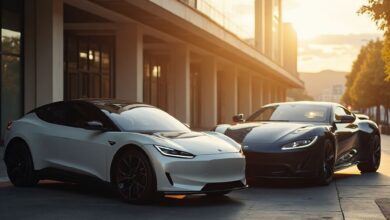
When Mercedes-Benz—the company that invented the automobile—announced a few years ago that it aimed to go “all-electric by 2030” where market conditions allow, it sent shockwaves across the industry. It was a bold declaration that positioned the luxury brand as a clear leader in the sustainable revolution.
However, in 2024 and 2025, that vision has met some real-world speed bumps. While Mercedes is still massively invested in EVs, the strict 2030 target has been replaced with a more flexible, and perhaps more realistic, strategy.
This news is important because it shows the immense challenges even giant, wealthy automakers face in transitioning away from gasoline.
The Original Vision (2021)
Mercedes-Benz’s initial plan was clear, aggressive, and backed by a massive investment:
- 2022: Offer a fully electric model in every segment (from compact SUVs to luxury sedans).
- 2025: Launch three new, electric-only vehicle platforms (MB.EA, AMG.EA, VAN.EA) for all future models.
- 2030: Be ready to sell only electric cars “where market conditions allow.” This was the big headline goal.
- Investment: A commitment of over €40 billion (around $43 billion) to EV development and production between 2022 and 2030.
This commitment wasn’t just about selling cars; it was about redesigning their entire manufacturing process and even acquiring new technology, like the high-performance electric motor company YASA in the UK.
The Strategic Pivot (2024–2025)
The reality of the global market proved to be less predictable than the plan. While EV sales continue to grow globally, the pace in many regions—including parts of Europe and the US—slowed down in 2024.
Facing this shift and intense competition, Mercedes-Benz made a public course correction in 2024, emphasizing flexibility.
Key Changes to the Plan:
| Original Goal | New Reality/Strategy |
| All-Electric by 2030 | Will continue building high-tech hybrid and combustion engines “well into the 2030s.” |
| 50% EV/Hybrid Sales by 2025 | Target adjusted to 50% EV/Hybrid sales by 2030 (a five-year delay). |
| Strict EV Focus | A dual-technology strategy—maintaining both EV and updated gasoline/hybrid models to meet varying customer demand across the world. |
CEO Ola Källenius stressed that the company needs to be prepared to cater to demand in all markets, especially where charging infrastructure is lacking or where consumers still prefer the range and familiarity of gasoline cars.
The Silver Lining: Why This is Good News for Buyers
While the “all-electric by 2030” headline has faded, the underlying investment in EV technology is still massive and is generating fantastic new cars.
Benefits of the New Strategy:
- More Efficient Hybrids: Mercedes is spending heavily to update its gasoline engines with high-tech hybrid systems, creating very efficient cars for buyers who aren’t ready for 100% electric.
- Better EVs are Coming: The commitment to the new MB.EA platform from 2025 onwards remains. This means that future Mercedes EVs, like the next-generation CLA-Class and the electric G-Class (EQG), will be built on pure EV foundations, leading to:
- Greater Range: Better battery placement and more efficient motors.
- More Space: Interiors designed only for electric power.
- Focus on Luxury and Charging: Mercedes is building its own dedicated fast-charging hubs globally. These are high-quality, reliable stations designed to give the luxury EV owner a premium charging experience.
Comparison: Mercedes vs. Competitors
Mercedes is now following a strategy similar to its German rivals, BMW and Audi.
| Brand | Primary Strategy | EV Target |
| Mercedes-Benz | Dual Strategy (Flexible) | Ready for all-electric if market conditions allow by 2030; otherwise, high-tech hybrids fill the gap. |
| BMW | Dual Strategy (Flexible) | Focused on offering “The Power of Choice,” building many models that can support both gas and electric platforms. |
| Tesla | EV-Only | Always 100% electric; sets the benchmark for efficiency and software. |
The key takeaway is that the transition is not a race to a finish line, but an evolution. Mercedes-Benz is prioritizing financial stability and customer choice over hitting an arbitrary date. They will still sell you a premium EV, but they won’t force you into one if your regional market isn’t ready.