How Porsche’s Taycan Proved That EVs Can Be Thrilling to Drive
For decades, the automotive world operated on a simple truth: if you wanted a truly thrilling, engaging driving experience, you needed a symphony of internal combustion, a finely tuned gearbox, and the unmistakable scent of high-octane fuel. Electric vehicles, while undeniably quick in a straight line, were often dismissed by purists as sterile appliances, soulless conveyances lacking the visceral connection that defines a true driver’s car. Then, in 2019, Porsche unleashed the Taycan, and with it, shattered every preconceived notion, proving definitively that electric power could not only match, but in many ways elevate, the art of driving.
The Dawn of a New Era: Why the Taycan Matters
Before the Taycan, the EV landscape was largely bifurcated. On one side, you had practical, efficient commuters, designed to minimize range anxiety and maximize eco-credentials. On the other, you had Tesla, which undeniably pushed the boundaries of straight-line acceleration and digital integration, but often left enthusiasts yearning for the tactile feedback, chassis poise, and sustained performance inherent to traditional sports cars. The question wasn’t if EVs could be fast, but if they could be *fun* – a question Porsche, a brand built on the very definition of driving pleasure, was uniquely positioned to answer.
The Taycan wasn’t just another EV; it was Porsche’s declaration that the electric future wouldn’t sacrifice the brand’s core identity. It was a commitment to engineering excellence, to translating the intangible “Porsche feel” into a new propulsion paradigm. This wasn’t merely about hitting impressive 0-60 mph times; it was about the entire dynamic envelope: the steering, the braking, the cornering prowess, and the ability to deliver sustained, repeatable performance without compromise. For car buyers and enthusiasts alike, the Taycan represented a pivotal moment, signaling that the electric revolution didn’t have to be a trade-off, but rather an evolution of the driving experience itself.
The Electrifying Heart of the Beast: Dissecting the Taycan’s Thrill
Design: An Unmistakable Porsche, Electrified
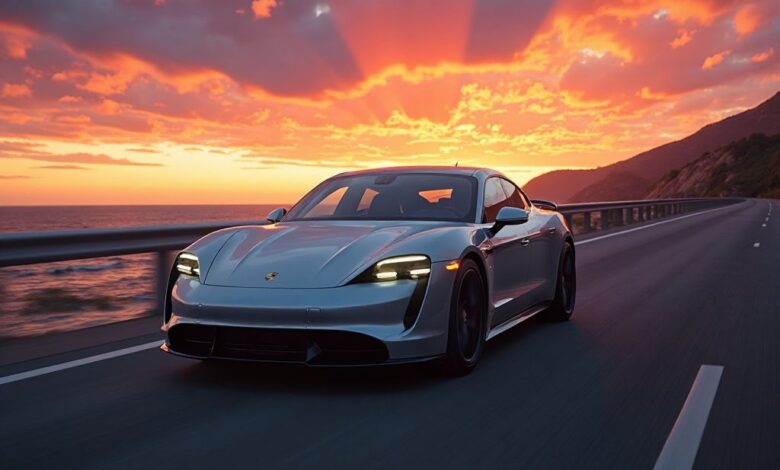
From the moment you lay eyes on the Taycan, there’s no mistaking its lineage. It’s a four-door sports sedan, yet its stance is pure Porsche – wide, low, and aggressive. The iconic headlight design, with its four-point LED daytime running lights, frames a deeply sculpted nose that hints at its aerodynamic efficiency. The flowing roofline seamlessly integrates into a muscular rear, punctuated by a continuous light strip. Every curve and crease serves a purpose, not just aesthetically, but functionally, guiding air to optimize downforce and cooling. It’s a design that screams performance, even at a standstill, and perfectly encapsulates the blend of tradition and innovation that defines the car.
Performance: Beyond Ludicrous Speed
This is where the Taycan truly shines and obliterates the “boring EV” stereotype. While its instant torque delivers neck-snapping acceleration (the Taycan Turbo S can hit 60 mph in a mind-bending 2.6 seconds), it’s the *way* it delivers that power, and its sustained performance, that sets it apart. Unlike most single-speed EVs, the Taycan features a revolutionary two-speed transmission on its rear axle, allowing for both blistering off-the-line acceleration in first gear and sustained high-speed performance and efficiency in second. This isn’t just about speed; it’s about the ability to repeatedly launch, corner, and brake with unwavering consistency, lap after lap, without thermal degradation.
The chassis is a masterpiece of engineering. Porsche Active Suspension Management (PASM) and optional Porsche Dynamic Chassis Control Sport (PDCC Sport) work in concert to provide a ride that is both compliant for daily driving and incredibly firm and flat when pushed to its limits. Optional rear-axle steering enhances agility at lower speeds and stability at higher speeds, making the Taycan feel far more nimble than its considerable weight suggests. The braking system, whether the standard high-performance setup, Porsche Surface Coated Brakes (PSCB), or the ultimate Porsche Ceramic Composite Brakes (PCCB), offers immense stopping power with incredible pedal feel – a crucial element for driver confidence and engagement. The Taycan doesn’t just go fast; it communicates with the driver, providing precise feedback through the steering wheel and seat, allowing you to dance on the edge of adhesion with confidence. Variants like the Taycan 4S, GTS, Turbo, and Turbo S, as well as the adventurous Cross Turismo and Sport Turismo models, offer a spectrum of power and capability, each retaining that quintessential Porsche driving DNA.
Interior: Digital Luxury, Driver-Focused
Step inside, and you’re greeted by a cabin that blends cutting-edge technology with Porsche’s signature driver-centric ergonomics and exquisite material quality. A curved 16.8-inch digital instrument cluster dominates the view, customizable to display everything from traditional gauges to a full-screen navigation map. The central 10.9-inch infotainment touchscreen, paired with an optional passenger display, provides intuitive control over vehicle functions, media, and navigation. Physical buttons are minimal, replaced by haptic feedback surfaces, yet crucial controls remain easily accessible. The seating position is low and sporting, with supportive seats that hold you firmly in place during spirited driving. While the rear seats offer decent comfort for two adults, taller passengers might find headroom a bit tight. The Taycan also offers practicalities like a decent-sized frunk (front trunk) and a conventional rear trunk, making it a surprisingly capable daily driver.
Technology: 800 Volts of Innovation
The Taycan’s most significant technological marvel lies beneath its skin: its 800-volt electrical architecture. This groundbreaking system allows for incredibly fast DC charging, capable of adding hundreds of miles of range in mere minutes at compatible chargers (up to 270 kW+). This dramatically reduces charging times compared to the more common 400-volt systems found in most other EVs, including many from Tesla. Beyond charging, the 800V system also allows for lighter wiring, contributing to overall efficiency. Porsche also offers a sophisticated suite of advanced driver-assistance systems (ADAS) and seamless integration with Apple CarPlay and Android Auto, ensuring connectivity and safety are on par with its performance.
Value for Money: The Price of Purity
There’s no sugarcoating it: the Porsche Taycan is an expensive car, with prices ranging from the mid-$80,000s for the base model to well over $200,000 for a fully optioned Turbo S. However, for that price, you’re not just buying an EV; you’re investing in a Porsche – a vehicle renowned for its engineering, build quality, and resale value. Compared to rivals like the Tesla Model S Plaid, the Taycan offers a more refined interior, superior build quality, and, crucially, a far more engaging and dynamically capable driving experience. It competes head-to-head with high-performance luxury sedans like the BMW M5 or Mercedes-AMG E63, offering similar levels of performance with the added benefits of instant torque and lower running costs (electricity vs. premium fuel). While the initial outlay is significant, the Taycan delivers an unparalleled blend of luxury, technology, and driving thrills that few, if any, other EVs can match.
Expert Analysis: Insider Insights into the Taycan’s Genius
Having spent countless hours behind the wheel of various Taycan models and dissected its engineering, here are a few insights that truly underscore its impact:
-
The Two-Speed Transmission isn’t a Gimmick, It’s a Game-Changer: Most EVs use a single-speed reduction gear, great for instant torque but less efficient at high speeds, where power delivery can taper off. Porsche’s two-speed gearbox ensures that the Taycan not only launches like a rocket but also maintains incredible acceleration and efficiency well into triple-digit speeds. This is crucial for track driving and sustained high-performance runs, setting it apart from even the quickest Tesla models that can feel breathless at their top end.
-
Translating “Porsche Feel” to Electric: This was arguably Porsche’s biggest challenge and their most significant triumph. They meticulously engineered the steering feel, brake pedal modulation, and chassis response to mimic the tactile feedback drivers expect from a 911 or Panamera. It’s not just about the numbers; it’s about the precision, the weight, and the linearity of controls that make the driver feel truly connected to the road, something often missing in other performance EVs.
-
The 800V Architecture’s Ripple Effect: While its immediate benefit is ultra-fast charging, the 800-volt system is a foundational technology. It allows for more compact and lighter wiring throughout the car, reducing weight and improving efficiency. This innovation isn’t just for Porsche; it’s a blueprint for the future of high-performance EVs across the entire Volkswagen Group, influencing models from Audi (like the e-tron GT, which shares the Taycan’s platform) to potential future Bentley or Lamborghini EVs.
-
Engineered Sound (or Silence): Porsche understood that a lack of engine noise could detract from the drama. They offer an optional “Porsche Electric Sport Sound” that synthesizes a futuristic, powerful hum, enhancing the sensation of speed without being artificial. But even in its absence, the Taycan’s silence amplifies other sensations – the rush of wind, the grip of tires, the subtle shifts in g-forces – creating a unique, almost meditative, high-performance experience.
-
The “Gateway Drug” for Purists: The Taycan has done more to convert skeptical Porsche purists to the EV cause than any other car. By demonstrating that electric power can coexist with, and even enhance, the core tenets of driving pleasure, it’s opened the eyes of many who once swore by internal combustion. It’