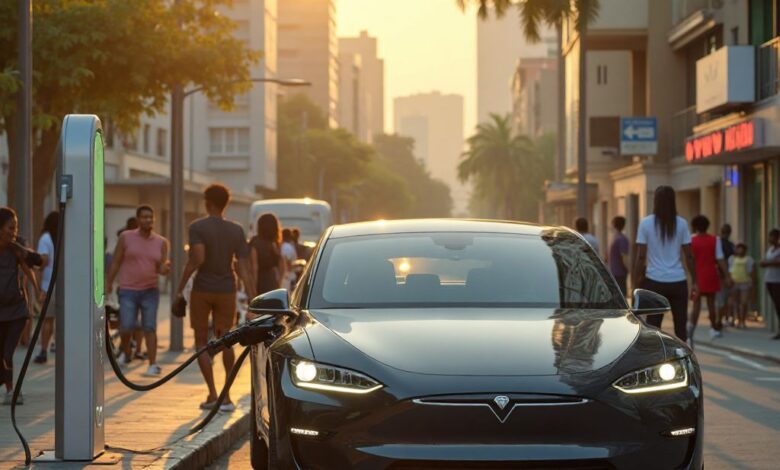
Sub-Saharan Africa’s Electric Revolution: How New EV Charging Networks Are Powering a Continent’s Future
Prepare to have your perceptions challenged: While many envision Sub-Saharan Africa as a region grappling with basic infrastructure, a silent, powerful revolution is underway, poised to redefine its automotive landscape. Forget the dusty roads and the ubiquitous petrol stations; a sophisticated, rapidly expanding network of electric vehicle charging stations is taking root, promising to transform everything from urban commutes to long-haul logistics. This isn’t just about a few isolated chargers; we’re witnessing the strategic deployment of modern, multi-standard charging hubs across key economic corridors, signaling a profound shift in how millions will move.
Why This Matters to Car Buyers and Enthusiasts Today
For years, the allure of electric vehicles in Sub-Saharan Africa remained largely theoretical. The dream of zero-emission driving, lower running costs, and reduced dependence on volatile fuel prices was often overshadowed by a stark reality: where would you charge it? Range anxiety wasn’t just a concern; it was a near certainty outside of a handful of major metropolitan areas. This infrastructure gap has been the single biggest inhibitor to widespread EV adoption, relegating electric cars to niche status, primarily for early adopters with home charging capabilities.
Today, that narrative is dramatically changing. The burgeoning charging networks are not merely facilitating EV ownership; they are actively driving demand and shaping market dynamics. For the discerning car buyer, this means the once-distant prospect of owning a Hyundai Kona Electric, a BMW iX, or even a future Ford F-150 Lightning becomes increasingly tangible and practical. For enthusiasts, it signifies the opening of new frontiers for performance EVs like the Porsche Taycan or the Audi e-tron GT, where the thrill of electric power can now be unleashed beyond city limits. This expansion isn’t just about filling batteries; it’s about unlocking a continent’s potential for sustainable mobility, offering a cleaner, often cheaper, and ultimately more advanced driving experience.
The Electrification Unfolding: A Detailed Look at Network Expansion
The expansion of EV charging infrastructure across Sub-Saharan Africa is a multi-faceted endeavor, involving a mix of private enterprise, government initiatives, and international partnerships. What started as sporadic installations has evolved into a strategic rollout designed to create viable EV ecosystems.
Key Players and Strategic Rollouts
Several pioneering companies and consortia are leading this charge. In South Africa, a regional economic powerhouse, entities like GridCars and ChargePoint have been instrumental. GridCars, for example, boasts a significant network of over 300 public charging points, including DC fast chargers strategically placed along major highways connecting cities like Johannesburg, Cape Town, and Durban. This allows for inter-city travel, a crucial step beyond urban-centric charging. Furthermore, partnerships with automotive brands like BMW and Nissan have seen dedicated charging points installed at dealerships and key locations, bolstering confidence for owners of models such as the BMW i3 and Nissan Leaf.
Beyond South Africa, other nations are rapidly catching up. Kenya, Rwanda, and Ghana are emerging as hotbeds for EV adoption and infrastructure development. In Kenya, companies like Opibus (now BasiGo) are not only deploying charging solutions but also electrifying public transport, installing charging depots for electric buses and matatus (shared taxis). This focus on commercial fleets is a clever strategy, guaranteeing high utilization rates for chargers and proving the economic viability of EVs in a high-demand environment.
Rwanda has made bold commitments to green mobility, attracting investment from companies like Volkswagen, which launched an EV pilot project and charging stations in Kigali. This initiative involved a fleet of e-Golfs and charging points powered by renewable energy, demonstrating a holistic approach to sustainable transport. Similarly, Ghana is seeing a surge in charging station installations, often integrated into shopping malls, hotels, and fuel stations, making charging accessible during daily routines.
Types of Charging and Accessibility
The networks are deploying a mix of charging speeds to cater to different needs. Level 2 AC chargers (typically 7-22 kW) are common at destinations like malls, offices, and residential complexes, suitable for overnight or workday charging. However, the game-changer for long-distance travel and rapid top-ups are the DC fast chargers (typically 50 kW to 150 kW and beyond). These are crucial for making premium EVs like the Mercedes-Benz EQS, Audi e-tron, or even the upcoming Rivian R1T viable for longer journeys. The proliferation of these fast chargers along national routes is effectively mitigating range anxiety, making an EV a practical primary vehicle rather than a city-bound secondary car.
Accessibility is also being enhanced through user-friendly apps that locate available chargers, manage payments, and monitor charging status. Many networks are adopting universal connectors (CCS2 and Type 2), ensuring compatibility with a wide range of EV models from manufacturers like Hyundai, Kia, Volkswagen, and even imported Tesla models.
What Comes Next: The Road Ahead
The immediate future will see continued densification of charging networks within urban centers and further expansion along key inter-city corridors. Governments are increasingly recognizing the economic and environmental benefits, leading to supportive policies, tax incentives, and potentially direct investment in charging infrastructure. We can expect to see more public-private partnerships, with energy companies playing a larger role in integrating charging solutions into the national grid. Furthermore, the push for local assembly and manufacturing of EVs in countries like South Africa and Kenya will create a virtuous cycle, driving both demand for vehicles and the infrastructure to support them.
Expert Analysis: Insider Insights from the Ground
Having watched this space closely for a decade, here are a few insights readers won’t find in every headline:
- Beyond the Grid: The Solar-Powered Imperative. A significant challenge for EV charging in some Sub-Saharan African regions is the reliability and capacity of the national grid. Savvy network operators are increasingly integrating solar power and battery storage solutions directly into their charging stations. This not only provides a resilient, off-grid charging option but also makes the entire EV ecosystem even greener, reducing reliance on fossil fuel-generated electricity. Think of it as a microgrid for your EV, a solution that could eventually be replicated globally.
- The “Two-Wheeler” Effect: Scaling from Scooters to Sedans. While our focus is on cars, the true groundswell of EV adoption in many African cities is starting with electric motorcycles and three-wheelers (tuk-tuks). The charging infrastructure for these smaller vehicles is often simpler and more distributed. The lessons learned and the public acceptance gained from electrifying this segment are directly informing the rollout strategies for passenger car charging, creating a foundational layer that accelerates broader EV adoption.
- Innovative Payment Models are Key. Unlike developed markets where credit card payments are standard, success in Sub-Saharan Africa often hinges on flexible, mobile-money-based payment systems. Companies that integrate popular platforms like M-Pesa (Kenya) or MTN Mobile Money (across multiple countries) into their charging solutions are seeing significantly higher user engagement. This removes a crucial barrier for many potential EV owners.
- “Corridor Electrification” as a Strategy. Instead of trying to blanket an entire country, the most effective strategy is “corridor electrification.” This involves building out robust charging infrastructure along specific, high-traffic economic routes first. This allows logistics companies, ride-hailing services, and individual drivers to confidently traverse known paths, proving the viability of EVs for practical use cases before broader, less utilized areas are tackled. This is where brands like Ford and Rivian, with their focus on utility and range, could find fertile ground.
- Localizing the Value Chain: The Manufacturing Boost. The long-term sustainability of EV charging networks is tied to the affordability of EVs themselves. As local assembly and manufacturing initiatives for brands like Volkswagen, Hyundai, and Kia gain traction in the region, the total cost of ownership for EVs will decrease. This, in turn, will drive greater demand for charging infrastructure, creating a powerful feedback loop that accelerates the entire transition.
Pros and Cons of This Charging Network Expansion
This rapid development brings with it a host of advantages, but also some inherent challenges.
Pros:
- Mitigated Range Anxiety: The primary barrier to EV adoption is being systematically dismantled, making EVs practical for a wider range of uses.
- Increased EV Viability & Choice: A robust network encourages more automotive brands (e.g., Tesla, Lucid, Chevrolet) to consider entering or expanding their presence in the market, offering consumers more options.
- Environmental Benefits: Reduced tailpipe emissions contribute to cleaner air in rapidly urbanizing areas and help combat climate change.
- Economic Growth & Job Creation: Investment in infrastructure creates jobs in installation, maintenance, and related services, fostering a new green economy.
- Reduced Fuel Import Dependence: Countries can lessen their reliance on imported fossil fuels, leading to greater energy security and potentially more stable local economies.
- Lower Running Costs for Consumers: Electricity, especially from renewable sources, is often cheaper and more stable than petrol or diesel, saving money for drivers.
Cons:
- Grid Stability and Capacity: Many national grids in Sub-Saharan Africa face challenges with reliability and capacity, which could strain the system as EV adoption grows.
- High Initial Investment: Building out extensive, high-power charging networks requires significant capital investment, which can be a hurdle.
- Geographic Disparities: While major corridors are being covered, vast rural areas will likely remain underserved for the foreseeable future.
- Cost of EVs: Even with improved infrastructure, the upfront cost of many EVs remains high for the average African consumer, limiting widespread adoption.
- Policy & Regulatory Hurdles: Inconsistent or evolving government policies can create uncertainty for investors and operators.
- Maintenance and Technical Expertise: Ensuring the long-term reliability and maintenance of advanced charging equipment requires skilled technicians, which can be a challenge to source and train locally.
Final Verdict: A Continent Electrifying, One Charger at a Time
The expansion of EV charging networks across Sub-Saharan Africa is not just a hopeful trend; it’s a foundational shift that is rapidly transforming the region’s automotive future. What was once a distant dream is becoming a tangible reality, with practical charging solutions making EVs a viable, and often superior, choice for a growing number of drivers. While significant challenges remain, particularly around grid stability and the initial cost of EVs, the momentum is undeniable.
For first-time buyers and experienced owners alike, this means the time to seriously consider an electric vehicle in Sub-Saharan Africa is now. The ecosystem is maturing, and the benefits of reduced running costs, environmental impact, and a superior driving experience are becoming increasingly accessible. The era of range anxiety is receding, replaced by the promise of electrifying journeys.
We recommend keeping a close eye on these developments. As an automotive enthusiast, there’s never been a more exciting time to witness a continent embrace the future of mobility. What are your thoughts on Africa’s electric future? Share your comments below and join the conversation!