

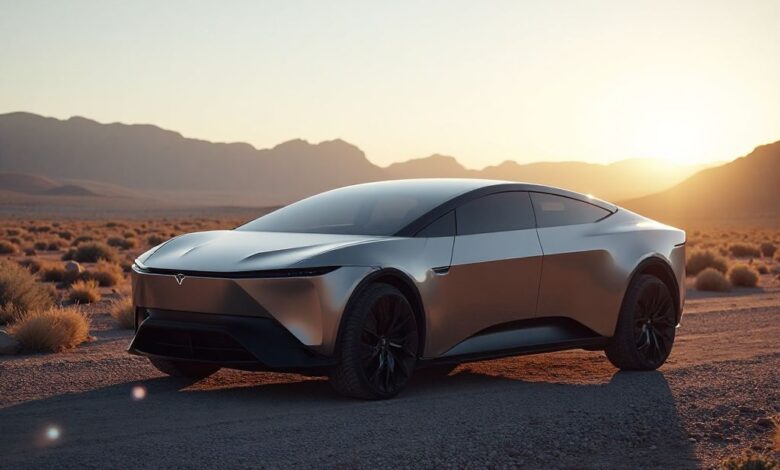
Tesla Cybertruck Review: Polarizing Design but Impressive Performance
Forget everything you thought you knew about pickup trucks. Forget the chrome grilles, the familiar curves, the decades of design evolution. Because the Tesla Cybertruck doesn’t just challenge those conventions; it obliterates them with the force of a stainless-steel meteor. It’s been called a doorstop on wheels, a polygon from the future, and a rolling provocation. But after years of anticipation, delays, and a truly unprecedented reveal, the Cybertruck is finally here, and it’s every bit as polarizing – and as impressively capable – as promised. This isn’t just a new truck; it’s a redefinition of what a truck can be, setting a new benchmark for conversation and capability in the automotive world.
Background: Why the Cybertruck Matters Now More Than Ever
The automotive landscape is undergoing a seismic shift, and the pickup truck segment, long considered the bastion of traditional internal combustion engines, is at the epicenter. The rise of electric trucks like the Rivian R1T and the Ford F-150 Lightning has already proven that utility and electrification can coexist, often with significant advantages in torque, efficiency, and innovative features. But Tesla, ever the disruptor, decided not to merely join the party; it aimed to crash it with a vehicle that looks like it drove straight out of a sci-fi movie set in 2077. The Cybertruck’s arrival isn’t just about adding another EV to the market; it’s about Tesla’s audacious bid to capture a significant share of America’s best-selling vehicle segment while pushing the boundaries of design, materials science, and manufacturing. For car buyers and enthusiasts today, the Cybertruck represents a pivotal moment: a test of whether radical innovation can truly resonate with a broad audience, or if it will forever remain a niche iconoclast.
Main Content: A Deep Dive into Tesla’s Stainless Steel Wedge
Design: A Brutalist Masterpiece or a Gimmick?
There’s no polite way to say it: the Cybertruck’s design is utterly unlike anything else on the road. Forged from ultra-hard 30X cold-rolled stainless steel, its angular, almost monolithic form is a direct consequence of its material and manufacturing process. There are no compound curves, no paint – just sharp lines, flat panels, and a raw, industrial aesthetic that screams post-apocalyptic utility. Love it or hate it, you cannot ignore it. The exterior’s tough exoskeleton promises superior dent and ding resistance, though repairability remains a question mark given its unique construction. The integrated tonneau cover for the 6-foot Vault bed is a clever touch, disappearing seamlessly to offer a secure, lockable cargo space. The full-width LED light bar upfront and the distinctive taillight signature ensure it’s unmistakable, day or night. While some find it aesthetically challenged, others laud its fearless originality and functional honesty. It’s a design that prioritizes strength and manufacturing simplicity over conventional beauty, and in doing so, creates its own category.
Performance: Ludicrous Speed Meets Truck Capability
Underneath that controversial skin lies a beast of performance. The Cybertruck is currently available in two main configurations: the dual-motor All-Wheel Drive and the tri-motor Cyberbeast. The All-Wheel Drive variant boasts 600 horsepower and 7,435 lb-ft of torque (at the wheels), rocketing from 0-60 mph in a breathtaking 4.1 seconds. The top-tier Cyberbeast, however, is where things get truly absurd, delivering 845 horsepower and an astounding 10,290 lb-ft of torque, enabling a supercar-rivalling 0-60 mph sprint in just 2.6 seconds. Yes, you read that right – a truck weighing over 6,800 pounds can out-accelerate many sports cars. This isn’t just about straight-line speed; the Cybertruck offers a maximum towing capacity of 11,000 pounds and a payload capacity of 2,500 pounds, putting it squarely in contention with traditional gasoline-powered heavy-duty trucks and significantly ahead of rivals like the Rivian R1T.
Off-road prowess is another highlight, thanks to an adaptive air suspension system that offers up to 16 inches of ground clearance in “Extract Mode.” Coupled with steer-by-wire technology and rear-wheel steering, the Cybertruck exhibits surprising maneuverability for its imposing size, making tight turns and navigating obstacles far easier than its dimensions suggest. Driving dynamics are stable and composed, albeit with a firmness that reminds you of its substantial weight. It feels planted, responsive, and utterly unlike any truck you’ve driven before.
Range & Charging: The Electric Truck Equation
Range figures are competitive but not class-leading, especially when considering towing. The All-Wheel Drive variant offers an EPA-estimated range of 340 miles, while the Cyberbeast is rated at 320 miles. An optional range extender (a toolbox-sized battery pack occupying about a third of the bed) can boost these figures significantly, though at the cost of cargo space. Charging, as with all Teslas, benefits from the industry-leading Supercharger network, offering V3 and V4 capabilities for rapid replenishment. Tesla claims up to 136 miles of range can be added in just 15 minutes on a Supercharger. The Cybertruck also boasts robust Vehicle-to-Load (V2L) capabilities, with multiple 120V and 240V outlets in the bed and cabin, making it a formidable mobile power station for tools, camping, or even home backup in a pinch.
Interior: Minimalist, Futuristic, and Surprisingly Spacious
Step inside, and the Cybertruck continues its minimalist, futuristic theme. The cabin is dominated by a single, massive 18.5-inch touchscreen that controls virtually every function, from climate to navigation to media. The controversial yoke steering wheel (now optionally available as a traditional round wheel) takes some getting used to, but the steer-by-wire system allows for variable ratios, making low-speed maneuvers surprisingly easy. Materials are durable and largely sustainable, designed to withstand the rigors of truck life. Seating for five is surprisingly comfortable and spacious, with ample head and legroom in both rows. Storage is clever, featuring a large frunk (front trunk) and under-seat compartments. Visibility, despite the angular design, is generally good forward, though the rear window is small and the sail pillars are thick, making the camera system indispensable for parking and backing up.
Technology: Beyond the Mainstream
As expected from a Tesla, the Cybertruck is packed with cutting-edge technology. The infotainment system is intuitive and responsive, offering a full suite of apps, gaming, and streaming services. Autopilot comes standard, and the optional Full Self-Driving (FSD) Beta package continues to evolve, offering increasingly sophisticated driver-assistance features, though it’s crucial to remember it’s still a Level 2 system requiring driver attention. Over-the-air (OTA) updates ensure the truck constantly improves, adding new features and refining existing ones. Unique tech touches include “Bioweapon Defense Mode” for its HEPA air filtration system and the aforementioned V2L capabilities, truly setting it apart from traditional trucks.
Value for Money & Costs: The Price of Innovation
The Cybertruck’s initial pricing was ambitious, but real-world delivery prices for the launch Foundation Series variants hover around the $100,000 mark for the All-Wheel Drive and $120,000 for the Cyberbeast. While not cheap, this positions it competitively against high-end trims of the Rivian R1T and the Ford F-150 Lightning Platinum. The total cost of ownership benefits from significantly lower “fuel” costs compared to an ICE truck, and Tesla’s typically low maintenance requirements. However, potential insurance costs for its unique stainless-steel body, which may require specialized repair techniques, are an unknown factor that could impact long-term expenses. Eligibility for federal tax credits also plays a role in its overall value proposition.
Expert Analysis: Insider Insights You Won’t Find Everywhere
- The Manufacturing Marvel: The Cybertruck’s unpainted stainless-steel exoskeleton isn’t just a design choice; it’s a manufacturing philosophy. Tesla has effectively turned the body into a structural component, simplifying the assembly process and potentially reducing production costs over time. This approach, combined with gigacasting technology, represents a significant departure from traditional automotive manufacturing, which could set new industry standards for efficiency, much like the Model Y’s structural battery pack. However, it also means any repair involving body panels is likely complex and expensive, potentially leading to higher insurance premiums.
- A True Segment Disruptor, Not Just an EV: While the Ford F-150 Lightning and Chevrolet Silverado EV aim to electrify the traditional truck experience, the Cybertruck is fundamentally trying to redefine it. Its form factor, materials, and integrated features (like the Vault bed and V2L) are not merely improvements but radical rethinking. This makes it less of a direct competitor and more of a category creator, pushing competitors like Rivian to consider more radical innovations in their next generations, rather than just optimizing existing designs.
- The “Unwearable” Aesthetic: The Cybertruck’s design is so extreme that it risks becoming quickly dated or remaining a niche item. While its “future-proof” stainless steel might suggest longevity, its stark, angular aesthetic could either become timeless or be seen as a relic of a very specific design era. Unlike the more universally appealing designs of a Porsche Taycan or a Mercedes EQS, the Cybertruck demands a specific taste, which could limit its broader market appeal and long-term resale value among conventional buyers.
- Software-Defined Truck: Beyond its hardware, the Cybertruck is a software platform on wheels. Tesla’s vertical integration, from battery cells to the operating system, allows for rapid iteration and feature deployment via OTA updates. This means the truck you buy today will likely be better, more capable, and feature-rich in a year or two. This is a significant advantage over legacy automakers, where software integration and updates are often an afterthought or limited to infotainment.
- The “Truck” Identity Crisis: Is it a truck for everyone? The Cybertruck excels in performance and tech, but its unique design and lack of a traditional bed wall (due to the sail pillars) might limit its appeal for those who use their trucks for specific, traditional work scenarios that require easy side access or specific aftermarket accessories. It’s a truck, but it’s a Tesla-defined truck, which means it might not fit everyone’s established definition of “truck utility.”
Brand Comparisons and Mentions
The Cybertruck enters a rapidly evolving electric truck arena. Its most direct rival is the Rivian R1T, which offers a more traditional, albeit modern, aesthetic with exceptional off-road capabilities and premium touches, appealing to the adventure-seeking luxury


