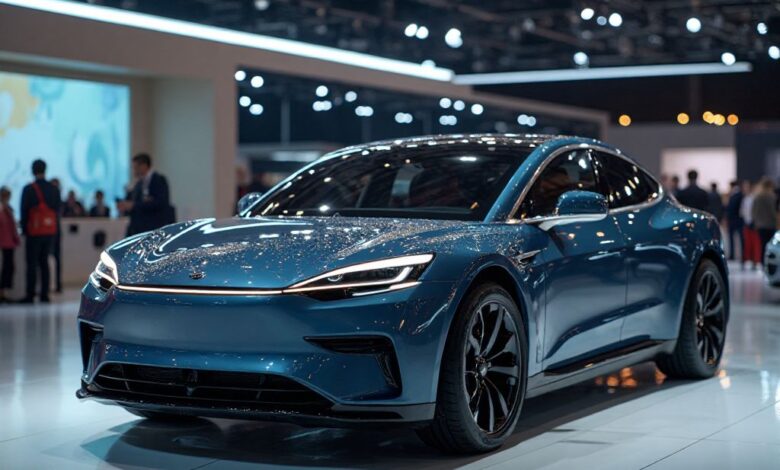
The 2026 Auto Shows: Electric Dreams Evolve into Tangible Reality
Hold onto your charging cables, automotive enthusiasts, because if the 2026 auto show circuit proved anything, it’s that the electric vehicle revolution isn’t just accelerating – it’s undergoing a profound metamorphosis. Forget the early days of range anxiety and limited choices; the future of mobility, as unveiled on the glittering stages of Detroit, Geneva, and Shanghai, is here, and it’s more diverse, sophisticated, and utterly compelling than ever before. In a bold declaration that sent ripples through the industry, one prominent CEO at the Geneva Motor Show proclaimed, “The internal combustion engine, while not entirely gone, has officially been relegated to niche status. The market has spoken, and the answer is electric.” This isn’t just a trend; it’s the new standard, and 2026 marks the year it truly became undeniable.
The Electrification Imperative: Why 2026 Matters More Than Ever
For years, the promise of electric vehicles has been a distant hum on the horizon. Now, in 2026, it’s a roaring reality, driven by a confluence of factors that make it impossible for any car buyer or enthusiast to ignore. Global climate targets are tightening, government incentives (and increasingly, mandates) are pushing the transition, and critically, the technology has matured to a point where EVs are no longer a compromise but often a superior choice. Fuel prices, while fluctuating, remain a persistent concern for many, making the prospect of cheaper “fueling” at home or public chargers incredibly appealing. Moreover, the driving experience itself – instant torque, whisper-quiet operation, and increasingly sophisticated autonomous features – is winning over even the most ardent petrolheads. This year’s announcements aren’t just about new models; they represent a seismic shift in manufacturing priorities, consumer expectations, and the very definition of what a car can be. Whether you’re a first-time buyer cautiously dipping your toes into the EV waters or an experienced owner looking for the next leap, the 2026 lineup offers something genuinely revolutionary.
The Star Players: Unveiling the Newest Electric Icons
The 2026 auto shows served as the global stage for a slew of groundbreaking EV introductions, showcasing advancements in every segment imaginable. Here are a few of the standout models that captured our attention and promise to reshape the automotive landscape.
Mercedes-Benz EQ-Sentry: The Apex of Electric Luxury
Mercedes-Benz pulled back the curtain on its flagship electric sedan, the EQ-Sentry, a vehicle designed to redefine ultra-luxury in the electric age. Building on the success of the EQS and EQE, the EQ-Sentry is an opulent statement of intent.
- Design: A sleek, monolithic form factor with an aerodynamic silhouette that hints at its efficiency. The ‘Hyperscreen 2.0’ spans the entire dashboard, offering an unparalleled digital experience.
- Performance: Available in multiple configurations, the top-tier EQ-Sentry 680 boasts over 850 horsepower, propelling this land yacht from 0 to 60 mph in a breathtaking 2.8 seconds.
- Range: Thanks to advanced battery chemistry and incredible aerodynamic efficiency (a drag coefficient of just 0.17 Cd), the EQ-Sentry is projected to achieve an astonishing 500+ miles on a single charge (EPA estimate).
- Charging: Equipped with an 800V architecture, the EQ-Sentry can add 200 miles of range in just 10 minutes using a compatible ultra-fast DC charger. Wireless charging capability is also standard.
- Costs: Expect a starting price north of $150,000, with fully optioned models easily exceeding $200,000. This positions it squarely against the likes of Lucid Air Sapphire and high-end Tesla Model S Plaid variants.
- Pros: Unrivaled luxury, groundbreaking range, blistering performance, cutting-edge technology, supreme comfort.
- Cons: Exorbitant price, large footprint might be challenging in urban environments, complex tech could have a learning curve.
Hyundai Ioniq 9: The Family-Friendly Electric SUV Reimagined
Hyundai, a consistent leader in accessible and innovative EVs, unveiled the Ioniq 9, a three-row electric SUV poised to disrupt the family vehicle market. This vehicle aims to blend practicality, striking design, and advanced EV tech at a competitive price point.
- Design: Carrying forward the Ioniq brand’s distinctive ‘Parametric Pixel’ styling, the Ioniq 9 features a robust, angular aesthetic with a spacious, airy cabin designed for family adventures.
- Performance: Dual-motor AWD variants are expected to produce around 450 horsepower, allowing for a 0-60 mph sprint in under 5.5 seconds – impressive for a vehicle of its size.
- Range: Hyundai estimates a robust 380 miles of range on a full charge for the long-range battery pack, making cross-country trips a breeze.
- Charging: Leveraging Hyundai’s E-GMP platform, the Ioniq 9 supports 800V fast-charging, enabling a 10% to 80% charge in approximately 18 minutes at a 350 kW DC fast charger.
- Costs: Starting at an estimated $62,000 for the base model, climbing to around $78,000 for the fully loaded AWD variant, the Ioniq 9 presents compelling value against rivals like the Kia EV9 and Ford Explorer EV.
- Pros: Excellent value, spacious three-row seating, rapid charging, distinctive design, comprehensive warranty.
- Cons: Not as luxurious as premium competitors, base model range might be slightly less competitive, infotainment system could feel overwhelming initially.
Porsche 718 e-Cayman: The Electric Enthusiast’s Dream
Perhaps the most anticipated reveal for driving purists was the all-electric Porsche 718 e-Cayman. This isn’t just an electric car; it’s a Porsche, meaning the driving experience remains paramount.
- Design: Instantly recognizable as a Cayman, the e-Cayman features subtle aerodynamic enhancements, a closed front fascia, and unique badging. Its proportions are perfectly balanced, a testament to Porsche’s engineering prowess.
- Performance: With multiple electric motors providing up to 600 horsepower in the top ‘GT4 RS e’ variant, the e-Cayman can hit 60 mph in a blistering 3.0 seconds. Porsche has focused heavily on weight distribution and chassis tuning to maintain its legendary handling dynamics.
- Range: Porsche targets a practical 320 miles of range, understanding that track day enthusiasts will prioritize performance over ultimate range.
- Charging: Equipped with a sophisticated 800V system, the e-Cayman can achieve a 10-80% charge in under 20 minutes, allowing for quick turnarounds between spirited drives.
- Costs: Pricing is expected to start around $90,000 for the base model, with performance variants pushing well past $120,000, placing it in direct competition with high-performance Tesla Model 3/Y variants and potentially even the upcoming electric BMW M cars.
- Pros: Unparalleled driving dynamics, instant torque, iconic design, premium build quality, surprisingly practical daily driver (for a sports car).
- Cons: Limited range compared to some luxury EVs, higher purchase price, charging infrastructure might still be a concern for track-day use.
Expert Analysis: Beyond the Brochure
As someone who’s spent a decade dissecting the automotive world, these announcements aren’t just about horsepower and range; they tell a deeper story about where the industry is headed. Here are 3-5 insider insights you won’t find on every press release:
- The Software-Defined Vehicle Takes Center Stage: What’s under the hood is still crucial, but the real battleground is software. Brands like Mercedes-Benz, with its Hyperscreen 2.0, and even Hyundai, are showcasing operating systems that are as critical as the powertrain. Over-the-air updates (OTAs) will not only fix bugs but fundamentally alter car capabilities post-purchase, leading to subscription models for features and an entirely new revenue stream for OEMs. This makes the car less of a static product and more of an evolving platform.
- 800V Architecture is the New Benchmark: The transition to 800V electrical architectures, pioneered by Porsche with the Taycan and adopted by Hyundai, Kia, and now Mercedes-Benz, is no longer a premium novelty. It’s becoming the expected standard for any serious new EV. This isn’t just about faster charging; it allows for lighter, more efficient components and better thermal management, fundamentally improving the EV experience across the board. Brands still clinging to 400V systems will quickly find themselves at a competitive disadvantage.
- The “Experience” Economy in EVs: It’s no longer just about getting from A to B. Manufacturers are keenly aware that the EV ownership experience must differentiate. This includes everything from bespoke interior materials, advanced augmented reality navigation, seamless integration with smart home ecosystems, to personalized driving modes that adapt to your mood. The EQ-Sentry’s focus on passenger comfort and silent operation, or the Ioniq 9’s family-centric tech, are prime examples of this shift.
- Battery Technology Diversification: While range figures are impressive, the underlying battery tech is diversifying. We’re seeing hints of solid-state batteries moving closer to production (though still a few years out for mass market), but also advancements in LFP (Lithium Iron Phosphate) for more affordable models, and silicon-anode batteries for higher energy density. This multi-pronged approach ensures that there’s a right battery solution for every segment and price point, rather than a one-size-fits-all approach.
- The Rise of ‘Lifestyle’ EVs: Beyond performance and luxury, brands are increasingly designing EVs around specific lifestyles. Rivian paved the way with adventure-focused vehicles, but now we’re seeing more specialized offerings. The Ioniq 9, for instance, isn’t just an SUV; it’s designed as a mobile hub for active families. This nuanced approach to market segmentation will create a far richer and more personalized EV landscape.
The New EV Wave: Pros and Cons
With these new models pushing the boundaries, it’s a good time to reassess the overall advantages and disadvantages of jumping into the electric future.
Pros:
- Stunning Performance: Instant torque provides exhilarating acceleration, often outperforming similarly priced ICE vehicles.
- Lower Running Costs: Cheaper “fuel” (electricity) and reduced maintenance (fewer moving parts, no oil changes).
- Environmental Benefits: Zero tailpipe emissions contribute to cleaner air and a reduced carbon footprint (depending on electricity source).
- Advanced Technology: EVs are often at the forefront of automotive tech, from infotainment to advanced driver-assistance systems (ADAS).
- Quiet & Smooth Ride: The absence of engine noise and vibrations creates a serene and comfortable driving experience.
- Improved Range & Charging: New models offer ranges well over 300 miles and significantly faster charging times.
Cons:
- Higher Initial Purchase Price: While decreasing, EVs often still carry a premium over comparable ICE vehicles.
- Charging Infrastructure Gaps: While improving rapidly, fast-charging networks can still be sparse in certain rural areas.
- Charging Time: Even with rapid charging,