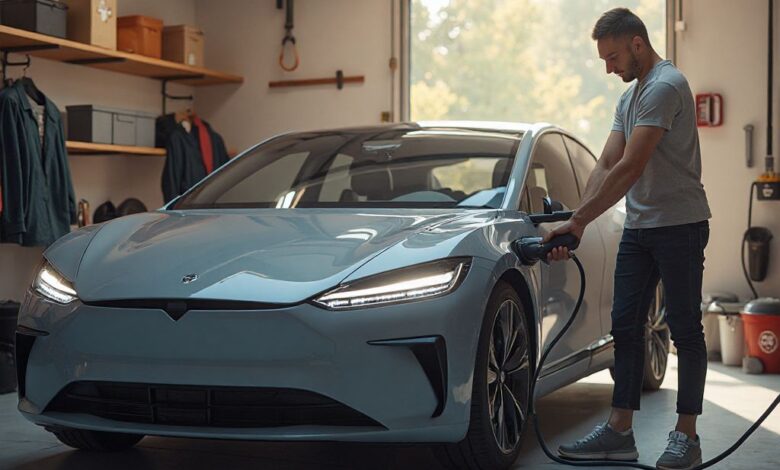
How to Charge Your Electric Car at Home Without an Electrician
Prepare for a revelation that might just change how you think about electric vehicle ownership forever: You absolutely, positively CAN charge your electric car at home without ever needing to call an electrician. Forget the costly installations, the confusing wiring, and the scheduling headaches. For a significant number of EV drivers, the simplest, most accessible form of home charging is already at your fingertips, requiring nothing more than what you already have in your garage or driveway. This isn’t just a convenient loophole; it’s the fundamental entry point into the world of electric mobility for millions, a secret weapon in the fight against range anxiety, and a testament to the surprising simplicity of going electric.
The Undeniable Appeal of Effortless EV Ownership
The electric vehicle revolution is in full swing, with exciting new models from nearly every major automaker hitting the streets. From the sleek efficiency of a Hyundai Ioniq 5 to the raw power of a Ford F-150 Lightning, the luxurious silence of a Mercedes EQS, or the groundbreaking technology of a Tesla Model 3, EVs are no longer a niche curiosity but a mainstream reality. However, for many prospective buyers and even current owners, the topic of home charging remains shrouded in a fog of misunderstanding. The perception often is that owning an EV necessitates a substantial electrical upgrade to your home, involving complex installations and significant expense. This misconception, more than almost anything else, acts as an unnecessary barrier to adoption, deterring countless individuals from experiencing the joy and environmental benefits of an electric car.
But here’s the truth: the vast majority of EVs sold today come equipped with everything you need to start charging at home, right out of the box, using nothing more than a standard 120-volt household outlet. This “Level 1” charging method is often overlooked in discussions dominated by faster Level 2 or ultra-rapid DC fast charging, but for daily commutes and topping off, it’s a game-changer. It democratizes EV ownership, making it accessible to renters, apartment dwellers, and homeowners alike, without the need for permits, contractors, or a deep dive into your home’s electrical panel. This article will demystify Level 1 charging, empowering you to confidently power your EV from the comfort of your home, no electrician required.
Understanding Level 1 Charging: The Unsung Hero of Home EV Power
When we talk about charging your electric car at home without an electrician, we are exclusively referring to Level 1 charging. This is the slowest but most universally accessible form of AC (Alternating Current) charging. Every single electric vehicle sold in North America, whether it’s a nimble Chevrolet Bolt EV, a sophisticated Audi e-tron, or a robust Rivian R1T, is capable of Level 1 charging, and most come with the necessary equipment included.
What is Level 1 Charging?
Level 1 charging simply means plugging your electric vehicle into a standard 120-volt household outlet – the same three-prong outlet you use for your toaster, laptop, or phone charger. The equipment you use is called an EVSE (Electric Vehicle Supply Equipment), often referred to colloquially as a “charger,” though the actual charger is built into your car. This EVSE typically comes with your car and has a standard NEMA 5-15 plug on one end (for the wall) and a J1772 connector (the standard for most EVs) or a Tesla connector (for Tesla vehicles) on the other end (for your car’s charge port).
Specs and Performance
Level 1 charging delivers power at a rate of approximately 1.4 to 1.9 kilowatts (kW). While this might sound modest, it translates to adding roughly 3 to 5 miles of range per hour of charging. To put that in perspective, if you plug in your EV for 10 hours overnight, you could add 30 to 50 miles of range. For many drivers, whose daily commute is less than 40 miles, this overnight trickle charge is perfectly sufficient to replenish their battery and start each day with a full “tank.”
Range Implications
Consider the average American drives around 30-40 miles per day. A Level 1 charger, plugged in for 8-12 hours overnight, can comfortably cover this daily mileage. This means that for the vast majority of EV owners, Level 1 charging isn’t just an emergency backup; it’s a perfectly viable, everyday charging solution. Owners of larger battery EVs like the Lucid Air or Porsche Taycan might find it slower to fully charge from empty, but for daily top-offs, it still works wonders. Even a Ford F-150 Lightning owner, with its massive battery, can benefit from Level 1 to slowly add miles back overnight, especially if they don’t drive long distances daily.
Costs
The cost of electricity varies by region, but charging at home is almost always significantly cheaper than public fast charging. With Level 1, your only “cost” is the electricity itself. There’s no installation fee, no expensive equipment purchase (since it comes with the car), and no monthly subscription. You’re simply paying your existing electricity bill, which will see a modest increase depending on your driving habits and electricity rates. Many utilities even offer off-peak rates, making overnight Level 1 charging even more economical.
Safety Considerations
While Level 1 charging is inherently safe due to its low power draw, a few best practices are crucial. Always plug your EVSE directly into a dedicated 120-volt outlet. Avoid using thin, household extension cords, as they are not designed for the continuous load of EV charging and can pose a fire hazard. If an extension cord is absolutely necessary, ensure it’s a heavy-duty, outdoor-rated cord specifically designed for high-amperage, continuous use. It’s also wise to check the condition of your outlet; if it’s loose or shows signs of wear, consider having a qualified person inspect or replace it (though this doesn’t require an electrician for the EV charging itself, just for basic electrical maintenance).
Expert Analysis: Beyond the Hype
Having spent a decade immersed in the automotive world, reviewing everything from budget hatchbacks to hypercars, I’ve seen countless myths perpetuated about electric vehicles. Here are a few insider insights regarding Level 1 charging that you won’t find in every spec sheet:
-
The “Trickle Charge” Misconception: Many dismiss Level 1 as merely a “trickle charger” suitable only for emergencies. This couldn’t be further from the truth. For the average driver, who commutes less than 50 miles daily, Level 1 is not just adequate; it’s optimal. It’s like filling a glass with a slow faucet – it takes time, but if you start with an empty glass every night, it’s full by morning.
-
Battery Health Benefits: Slower charging, like Level 1, is generally gentler on an EV’s battery pack compared to constant DC fast charging. While modern battery management systems are incredibly sophisticated, charging at lower rates generates less heat and stress, potentially contributing to a longer overall battery lifespan. Think of it as a leisurely stroll versus a sprint for your battery cells.
-
The “Dedicated Circuit” Advantage: While you *can* plug Level 1 into any functional 120V outlet, ideally, you should use an outlet on a dedicated circuit. This means the circuit breaker for that outlet only powers that one outlet, preventing tripping issues if other appliances are drawing power simultaneously. It’s not a requirement, but it ensures uninterrupted charging and peace of mind.
-
Future-Proofing Your Home: Starting with Level 1 doesn’t mean you’re stuck there. It’s the perfect way to get acquainted with EV ownership and understand your actual charging needs. Many drivers realize Level 1 is enough. If your driving habits change, or you eventually desire faster charging, upgrading to Level 2 (which does require an electrician) is always an option down the road. It’s an incremental approach to home energy management.
-
Unlocking Apartment Living: For apartment dwellers or those with shared parking, Level 1 charging is often the only practical solution without complex building modifications. If you have an outdoor outlet or a garage outlet accessible from your parking spot, you’re in business. This opens up EV ownership to a demographic often excluded from the “home charging” narrative.
Brands and Their Level 1 Readiness
Every major EV manufacturer recognizes the importance of accessible charging. From the moment you pick up your new vehicle, you’re equipped for Level 1 charging:
-
Tesla: Tesla vehicles (Model 3, Model Y, Model S, Model X, Cybertruck) come with a Mobile Connector. Out of the box, it includes an adapter for a standard NEMA 5-15 (120V) outlet, making Level 1 charging immediately available. Tesla also offers various NEMA adapters for higher voltage outlets, but the basic 120V option is always there.
-
Ford, Chevrolet, Rivian: The Ford F-150 Lightning, Mustang Mach-E, Chevrolet Bolt EV/EUV, and Rivian R1T/R1S all come with a portable EVSE that plugs directly into a standard 120V outlet, featuring the universal J1772 connector.
-
Hyundai, Kia, Volkswagen: Popular models like the Hyundai Ioniq 5, Kia EV6, and Volkswagen ID.4 likewise include a Level 1 EVSE as standard equipment, ready for immediate use with their J1772 ports.
-
Audi, BMW, Mercedes, Porsche, Lucid: Even luxury EVs such as the Audi e-tron, BMW iX, Mercedes EQS, Porsche Taycan, and Lucid Air include a portable charging cord that supports Level 1 charging, ensuring that premium EV owners also have this foundational charging option available from day one.
The message is clear: regardless of the brand or price point, the ability to charge your EV at home, without an electrician, is a standard feature.
Pros and Cons of Level 1 Home Charging
Like any technology, Level 1 charging has its strengths and weaknesses:
Pros:
- No Electrician Required: The most significant advantage. Plug and play, no installation costs or permits.
- Lowest Cost of Entry: The equipment comes with your car, so there are no additional hardware costs.
- Universal Accessibility: Any standard 120V outlet works, making it ideal for renters, apartment dwellers, and homes without a dedicated Level 2 setup.
- Gentle on Battery: Slower charging is generally better for long-term battery health.
- Perfect for Low-Mileage Drivers: Easily replenishes daily commute range for most users.
- Simple and Convenient: Just plug in overnight, no complex settings or schedules needed beyond your car’s built-in timers.
Cons:
- Very Slow: Adds only 3-5 miles of range per hour, which can be insufficient for high-mileage drivers or large battery vehicles needing a quick turnaround.
- Long Full Charge Times: Charging a large battery EV from empty to full can take days, not hours.
- Can Trip Older Circuits: If the outlet is on a circuit with other high-draw appliances, it might trip the breaker, especially in older homes.
- Not Ideal for Road Trips: Cannot quickly add significant range for spontaneous long-distance travel.
- Limited Power Sharing: Using a shared circuit can be problematic if other devices are in use.
Final Verdict: Embrace the Simplicity, Drive Electric!
The notion that home EV charging is inherently complex or expensive is a myth that needs to be debunked. Level 1 charging, while slow, is a profoundly effective, convenient, and cost-free way to power your electric car right from your own home, without the need for a single call to an electrician. It’s the foundational step into EV ownership, offering unparalleled accessibility and ease of use. For the average driver, who covers 30-50 miles daily, plugging into a standard wall outlet overnight provides more than enough juice to keep you going.
So, if the thought of electrical upgrades has been holding you back from embracing the electric revolution, let this be your permission slip to proceed. Test your daily driving needs, consider an EV, and rest assured that you can start your electric journey with nothing more than the charging cable that comes with your car and