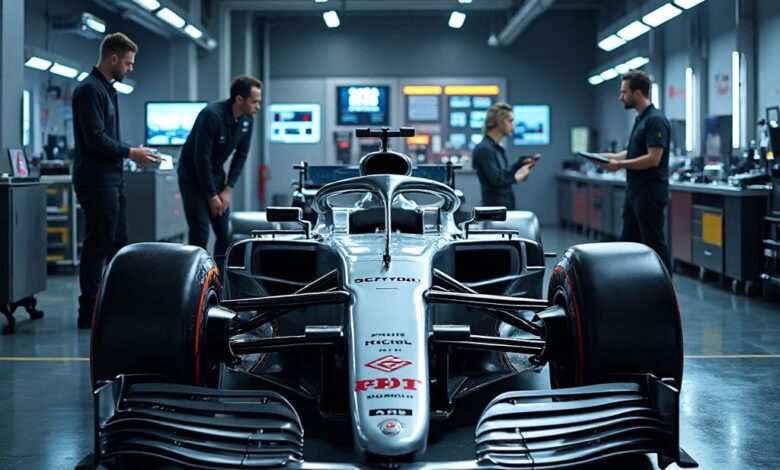
How Formula 1 Is Using New Technology That Will Reach Consumer Cars
Imagine a world where your daily commute feels a little more like a Sunday race, where the hum of your engine hints at a beast tamed from the track, and where your car’s efficiency is a direct descendant of the pinnacle of motorsport. Sounds like science fiction? Think again. The staggering pace of innovation in Formula 1 isn’t just for million-dollar race cars; it’s a high-octane incubator for technologies that are already shaping, and will continue to define, the cars we drive every day.
Did you know that the energy recovery systems in a modern F1 car are so advanced they can capture and redeploy enough power to light up a small town? This isn’t just about raw speed; it’s about extreme efficiency, durability, and performance under the most demanding conditions imaginable. What happens when these cutting-edge solutions, honed in the crucible of Grand Prix racing, find their way into the consumer automotive market? The answer is nothing short of revolutionary.
The Race Track as a Proving Ground: Why F1 Tech Matters to You
For decades, Formula 1 has been more than just a sport; it’s been an unparalleled research and development laboratory on wheels. The relentless pursuit of a competitive edge – shaving milliseconds off lap times, extending fuel range, or improving driver safety – pushes engineers to invent solutions that transcend the immediate needs of racing. This trickle-down effect isn’t a new phenomenon; disc brakes, turbocharging, and even rearview mirrors all have roots in motorsport.
But in today’s rapidly evolving automotive landscape, the transfer of technology from F1 to road cars is accelerating like never before. With the industry facing immense pressure to improve fuel economy, reduce emissions, enhance safety, and embrace electrification, the lessons learned at 200 mph on tracks like Monza and Monaco are more relevant than ever. Car buyers and enthusiasts alike should pay close attention, because the future of your next vehicle is being forged on the F1 grid right now.
From Grid to Garage: Key F1 Technologies Shaping Consumer Cars
Hybrid Powertrains and Energy Recovery Systems (ERS)
Perhaps the most significant and direct transfer of F1 technology to consumer cars comes in the form of hybrid powertrains and sophisticated Energy Recovery Systems. F1 cars have been hybrid since 2014, utilizing a complex system of Motor Generator Units (MGU-K for kinetic energy, MGU-H for heat energy from the turbo) to recover energy typically lost during braking and exhaust heat. This captured energy is then stored in a high-voltage battery and deployed for extra power or increased efficiency.
This principle is directly applied in high-performance hybrid road cars. The Mercedes-AMG ONE hypercar, for instance, literally uses a detuned version of Mercedes’ F1 power unit, complete with MGU-H and MGU-K technology. While such extreme implementations are rare, the underlying concepts of efficient energy recovery and intelligent power deployment are becoming commonplace. Luxury brands like Porsche with the 918 Spyder and Ferrari with the SF90 Stradale have embraced advanced hybrid systems that leverage F1-derived knowledge in battery management, electric motor integration, and power electronics to deliver both blistering performance and surprising efficiency. Even more mainstream hybrids from Toyota or Hyundai benefit from the fundamental understanding of optimizing power flow and energy capture, albeit in a less extreme form.
Advanced Aerodynamics
In F1, aerodynamics is king. Every surface, every curve, every wing is meticulously sculpted to maximize downforce for grip and minimize drag for speed. While you won’t see giant rear wings on a family sedan, the principles of F1 aero are subtly influencing road car design.
Active aerodynamics, once exclusive to F1, is now found on performance cars like the Porsche 911 GT3 RS and the Mercedes-AMG GT Black Series, featuring deployable spoilers and adjustable flaps that adapt to driving conditions. Brands like Audi and BMW are integrating sophisticated underbody aero elements, air curtains, and diffusers to improve stability and fuel efficiency. Even the subtle sculpting of a car’s side mirrors or the shape of its door handles are informed by aerodynamic efficiency studies, directly benefiting range in EVs like the Lucid Air and reducing wind noise in luxury cruisers.
Lightweight Materials and Structural Integrity
F1 cars are marvels of lightweight engineering, utilizing exotic materials like carbon fiber, titanium, and advanced composites to create incredibly strong yet feather-light structures. The entire chassis of an F1 car is a carbon fiber monocoque, offering unparalleled rigidity and safety.
This push for lightweighting has made its way into consumer vehicles, particularly in performance and electric cars. While a full carbon fiber monocoque is too expensive for most production cars, carbon fiber is increasingly used in specific components: roof panels on BMW M cars, body panels on the Ford GT, or structural elements in McLaren’s entire lineup. The BMW i3 famously used a carbon fiber passenger cell, demonstrating how F1 materials can be adapted for mass production to offset the weight of large battery packs in EVs. The expertise gained in F1 in bonding different materials and optimizing crash structures also trickles down, making our cars safer and more efficient.
Thermal Management
Managing heat is crucial in F1. Engines, brakes, and now battery packs generate immense heat that must be efficiently dissipated or, in some cases, recovered. F1 engineers are masters of complex cooling systems and heat exchangers.
This expertise is vital for modern road cars, especially high-performance vehicles and EVs. Efficient cooling systems prevent overheating in powerful engines and maintain optimal operating temperatures for batteries in electric vehicles. Advanced thermal management ensures consistent performance, extends battery life, and enables faster charging, areas where brands like Tesla and Rivian are constantly innovating. Even the design of a car’s grille and air intakes is optimized for cooling efficiency, a direct influence from motorsport’s relentless pursuit of thermal control.
Advanced Telemetry and Data Analytics
F1 teams gather terabytes of data during every session – tire temperatures, suspension loads, engine parameters, driver inputs. This telemetry is analyzed in real-time to make critical decisions and optimize performance. This data-driven approach is transforming road cars.
Modern vehicles are essentially computers on wheels, collecting vast amounts of data. This F1-inspired approach to data acquisition and analysis helps manufacturers refine everything from engine mapping and transmission shifts to suspension tuning and advanced driver-assistance systems (ADAS). Predictive maintenance, over-the-air updates, and personalized driver settings are all manifestations of this data-centric philosophy, making cars smarter, safer, and more connected. Brands like Audi and Mercedes-Benz are at the forefront of integrating sophisticated driver information systems that owe a debt to F1’s complex dashboards and real-time feedback.
Expert Analysis: Beyond the Surface
- **The Convergence of Challenges Accelerates Transfer:** The automotive industry’s current focus on electrification and sustainability perfectly aligns with F1’s hybrid era. Both are tackling similar problems – maximizing energy efficiency, lightweighting, and thermal management – but F1 does it at an extreme, accelerating solutions that then get refined for consumer applications. The speed of transfer is unprecedented.
- **F1 as a “Worst-Case Scenario” Test Bed:** Road cars are designed for average conditions. F1 cars are designed for the absolute limit. This means F1 tech is inherently over-engineered for road use, providing a robustness and reliability that might not be achieved if developed solely for consumer vehicles. It’s about building solutions that can withstand the most punishing environments imaginable.
- **The “Democratization” of Exotic Materials:** While full carbon fiber tubs remain exclusive, F1’s innovation in manufacturing processes for advanced composites is making these materials more accessible. Expect to see more localized carbon fiber reinforcement, advanced plastics, and hybrid material structures in mainstream cars, not just supercars, reducing weight and improving crash safety.
- **Driver-Machine Interface Refinement:** The complexity of an F1 steering wheel, managing multiple modes and settings, has pushed the boundaries of human-machine interface (HMI). This expertise in intuitive control and clear feedback is directly influencing the sophisticated infotainment systems and driver controls in high-end road cars, making complex features easier for the driver to manage safely.
- **The Sustainability Mandate’s Future Impact:** F1’s commitment to 100% sustainable fuels by 2026 isn’t just a racing initiative; it’s a direct signal to the broader automotive and energy sectors. The research and development into advanced biofuels and synthetic fuels will undoubtedly influence the energy landscape for internal combustion engines for decades to come, offering a potential lifeline for traditional powertrains alongside EVs.
Pros and Cons of F1 Technology in Consumer Cars
- **Pros:**
- **Enhanced Performance:** More power, better handling, quicker acceleration derived from racing innovation.
- **Improved Efficiency:** Better fuel economy for ICE vehicles, extended range for EVs through advanced aerodynamics and energy recovery.
- **Increased Safety:** Stronger, lighter materials and sophisticated crash structures.
- **Superior Driving Dynamics:** More precise steering, better braking, and advanced suspension systems.
- **Cutting-Edge Features:** Advanced telemetry, active aero, and sophisticated driver aids.
- **Quicker Innovation Cycle:** Racing pushes boundaries faster than traditional R&D.
- **Cons:**
- **Increased Costs:** Exotic materials and complex systems often translate to higher vehicle prices.
- **Complexity:** More advanced systems can be more expensive to repair or maintain.
- **Limited Accessibility:** The most extreme F1-derived technologies remain exclusive to high-end performance or luxury vehicles.
- **Over-Engineering:** Some solutions might be overkill for everyday driving needs.
Final Verdict: The Future is Fast, Efficient, and F1-Inspired
The synergy between Formula 1 and consumer automotive technology is undeniable and growing stronger by the season. From the sophisticated energy recovery systems powering the latest Mercedes-AMG and Porsche hybrids to the lightweight carbon fiber structures found in McLaren and BMW models, the influence of the world’s premier motorsport is everywhere. It’s not just about speed; it’s about pushing the boundaries of efficiency, safety, and driver experience.
For first-time buyers and seasoned enthusiasts alike, understanding this connection offers a glimpse into the future of automotive innovation. Your next car, whether an economical commuter or a high-performance luxury sedan, will undoubtedly carry the DNA of a Formula 1 race car in ways you might not even realize. So, as you browse showrooms or research your next purchase, remember that the pursuit of glory on the racetrack is directly contributing to a safer, more efficient, and undeniably more exciting driving experience for you on the road. Embrace the future; it’s going to be a thrilling ride.
What F1 tech are you most excited to see in your next car? Share your thoughts and join the conversation!