

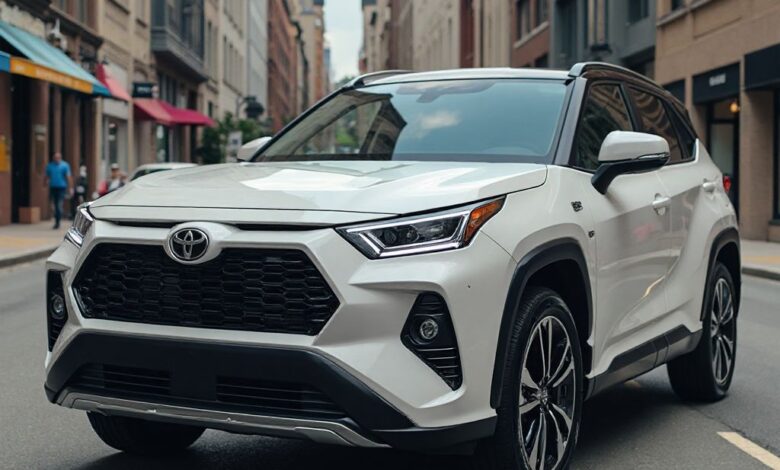
Toyota bZ4X Review: Does Toyota’s First Real EV Live Up to the Name?
For decades, Toyota has been the undisputed champion of automotive electrification. They practically invented the mainstream hybrid with the Prius, and their mastery of efficient powertrains has been legendary. Yet, when the full-electric revolution truly kicked off, Toyota, surprisingly, found itself playing catch-up. While rivals like Tesla, Hyundai, Kia, and Ford were launching compelling, long-range EVs, Toyota remained cautiously on the sidelines. Now, with the launch of the bZ4X – their first dedicated, mass-market battery-electric vehicle – the question isn’t just if it’s a good EV, but if it lives up to the colossal expectations placed upon the brand that pioneered electrification. Does Toyota’s long-awaited entry truly deliver, or is it a case of too little, too late?
The Electric Tsunami: Why Toyota’s EV Entry Matters Now More Than Ever
The automotive landscape is undergoing a seismic shift. Fuel prices are volatile, environmental concerns are paramount, and government regulations worldwide are pushing for a rapid transition to zero-emission vehicles. For car buyers and enthusiasts, this means a flood of new electric models, each promising more range, faster charging, and thrilling performance. Brands like Tesla have redefined expectations, while newcomers like Rivian have carved out niches, and established players like Ford with the Mustang Mach-E, Hyundai with the Ioniq 5, and Kia with the EV6 are pushing boundaries with innovative designs and 800-volt charging architectures.
Toyota, with its unparalleled reputation for reliability and quality, has a unique position. Their hybrid technology paved the way, educating millions of drivers about the benefits of electrification. But the leap from hybrid to a pure EV is significant, requiring different engineering philosophies and a new understanding of consumer demands. The bZ4X isn’t just another model; it’s a critical litmus test for Toyota’s ability to compete in this rapidly evolving, high-stakes EV market. Its success or failure will dictate much of Toyota’s strategy for the coming decade, making this review particularly crucial for anyone considering an EV today.
Deep Dive: Unpacking the Toyota bZ4X
Design: Futuristic Yet Familiar
The bZ4X certainly looks the part of a modern EV. Its exterior design is sharp, angular, and decidedly futuristic, yet still recognizably Toyota. Sharing its e-TNGA platform and much of its body with the Subaru Solterra, the bZ4X sports aggressive, hammerhead-like front lighting, prominent wheel arches, and a sleek, coupé-like roofline. It’s roughly the size of a RAV4 but with a much more dynamic stance, pushing the wheels out to the corners for a long wheelbase that benefits interior space. While some critics find it a bit busy, I find it a refreshing departure from Toyota’s more conservative designs. It effectively communicates its electric identity without resorting to outlandish concepts, striking a balance that should appeal to a broad audience.
Performance: Adequate, Not Exhilarating
Underneath that striking exterior, the bZ4X offers a choice of two powertrains. The front-wheel-drive (FWD) model uses a single electric motor delivering 201 horsepower, while the all-wheel-drive (AWD) variant employs two smaller motors (one on each axle) for a combined 214 horsepower. Yes, you read that right – only a marginal increase for AWD. This is a noticeable contrast to many rivals where AWD often means a significant power bump. Acceleration is adequate: 0-60 mph comes in around 7.5 seconds for the FWD and a more respectable 6.5 seconds for the AWD. These figures are perfectly fine for daily driving and merging onto highways, but they won’t pin you to your seat like a Tesla Model Y or even a Hyundai Ioniq 5. The bZ4X prioritizes smooth, predictable power delivery over raw grunt. The ride quality is commendable, absorbing bumps with composure, and the steering is light but precise enough for urban maneuvers. For those seeking a thrill ride, look elsewhere; for a comfortable, quiet commuter, the bZ4X delivers.
Range and Charging: The Achilles’ Heel?
Here’s where the bZ4X starts to show some cracks. The FWD model, equipped with a 71.4 kWh battery, boasts an EPA-estimated range of 252 miles. The AWD model, with a slightly larger 72.8 kWh battery, sees its range drop to 228 miles. These numbers are competitive with some entry-level EVs, but they fall short of segment leaders and even some similarly priced options. Real-world range, especially in colder climates, tends to be lower, which is a common EV characteristic but feels more pronounced here.
The charging story is even more concerning. Level 2 (AC) charging tops out at a rather slow 6.6 kW, meaning a full charge from empty will take between 9.5 to 11 hours. Many competitors, like the Ioniq 5 and EV6, offer 11 kW AC charging, significantly reducing home charging times. DC fast charging is the bZ4X’s biggest letdown. While the FWD model can theoretically hit 150 kW, the AWD model is capped at a paltry 100 kW. To put this in perspective, many new EVs, especially those from Hyundai and Kia, utilize 800-volt architectures that allow for charging speeds well over 200 kW, often reaching 350 kW, enabling an 80% charge in under 20 minutes. The bZ4X, by contrast, takes closer to an hour for an 80% charge, and its charging curve is known to taper off significantly, especially after repeated fast-charging sessions. This makes longer road trips a more time-consuming affair than they need to be, a critical factor for first-time EV buyers.
Interior and Technology: A Mixed Bag of Innovation and Familiarity
Step inside, and the bZ4X presents a cabin that is both modern and distinctly Toyota. The high-mounted digital gauge cluster, positioned above the steering wheel, is a unique design choice that takes some getting used to but aims to keep your eyes closer to the road. The large 12.3-inch central touchscreen runs Toyota’s latest infotainment system, which is a significant improvement over previous generations. It’s intuitive, responsive, and supports wireless Apple CarPlay and Android Auto. Physical buttons for climate control and volume are a welcome touch, preventing over-reliance on the screen.
Interior materials are a mix of soft-touch surfaces, unique fabric accents, and some harder plastics, creating a pleasant but not luxurious ambiance. Passenger space is generous, particularly legroom in the rear, thanks to the long wheelbase. However, the fixed panoramic glass roof (which lacks a sunshade) can eat into headroom for taller occupants and contribute to cabin heat on sunny days. Cargo space is decent, but there’s no frunk (front trunk), a convenience feature found in many EVs that’s surprisingly absent here. Toyota Safety Sense 3.0 (TSS 3.0) comes standard, offering a comprehensive suite of driver-assist features, including adaptive cruise control, lane-keeping assist, and pre-collision systems, all of which operate smoothly and reliably.
Value for Money: A Question of Priorities
The bZ4X’s pricing places it squarely in the competitive compact EV SUV segment, going head-to-head with the likes of the Tesla Model Y (base RWD), Volkswagen ID.4, Ford Mustang Mach-E, and its Korean rivals. While it offers a comfortable ride, a decent array of standard features, and the peace of mind that comes with a Toyota badge, its modest performance, limited range, and particularly its slow charging speeds make its value proposition a bit challenging. Buyers might find more range, faster charging, or more exhilarating performance for similar money elsewhere. However, for those who prioritize Toyota’s legendary reliability and a comfortable, no-fuss electric driving experience for primarily local commuting, the bZ4X could still hold appeal, especially if strong dealer incentives or favorable lease deals are available.
Expert Analysis: Beyond the Spec Sheet
1. Toyota’s Conservative Playbook: The bZ4X feels like Toyota’s cautious first step rather than a bold leap. This reflects their long-held strategy of prioritizing reliability and incremental improvement over bleeding-edge technology. They’re clearly aiming for a “no surprises” EV experience, banking on their brand loyalty and reputation. This approach might appeal to hybrid owners making their first EV switch, but it risks alienating tech-savvy early adopters who expect more from a dedicated EV platform.
2. The e-TNGA Platform’s Limitations: While the e-TNGA platform provides a solid foundation for ride and handling, its first iteration doesn’t seem optimized for high-speed charging. The decision to cap the AWD model’s DCFC at 100 kW, especially when the FWD can do 150 kW, is baffling. It suggests potential thermal management issues or a deliberate choice to prioritize battery longevity over charging speed, a very “Toyota” move, but one that puts it at a significant disadvantage against 800V rivals.
3. A Learning Platform: It’s plausible that the bZ4X (and its Subaru twin) serves as a crucial learning platform for Toyota. They’re gathering real-world data on EV battery performance, charging habits, and consumer preferences before unleashing their next generation of EVs. This is a common strategy for large, established automakers, but it means early adopters of the bZ4X are essentially participating in Toyota’s R&D phase.
4. The Frunk Fumble: The absence of a frunk is a missed opportunity. It’s a practical, convenient feature unique to many EVs, offering extra secure storage for charging cables or small bags. Its omission, along with the lack of a panoramic roof cover, points to some design oversights that detract from the overall user experience.
5. Betting on Hydrogen? Toyota’s continued investment in hydrogen fuel cell technology (as seen with the Mirai) may also explain some of their EV conservatism. They’re not putting all their eggs in the battery-electric basket, which could be seen as prudent diversification or a distraction from fully committing to BEVs.
Brand Comparisons: Where Does the bZ4X Stand?
- Tesla Model Y: The Model Y offers superior performance, range, and access to Tesla’s industry-leading Supercharger network, but often at a higher price point and with a more minimalist, screen-centric interior


