

Volkswagen ID.4 Review: A Solid Family EV With One Major Weakness
Prepare for a revelation: The Volkswagen ID.4, a vehicle many initially dismissed as merely VW’s belated entry into the mainstream electric SUV market, is quietly becoming one of the most important EVs on the road today. It’s not just another electric car; it’s a testament to Volkswagen’s audacious pivot towards an all-electric future, and for many families, it represents the most sensible, approachable, and genuinely livable EV option available. But don’t be fooled by its unassuming charm; beneath the surface of this family-friendly electric crossover lies a singular, frustrating flaw that can significantly dampen an otherwise excellent ownership experience.
The Electric Wave: Why The ID.4 Matters More Than Ever
In an automotive landscape increasingly dominated by electric vehicles, the Volkswagen ID.4 holds a unique and crucial position. As governments push for greener transportation, fuel prices remain volatile, and charging infrastructure slowly but steadily expands, more and more everyday car buyers are considering an EV for their next purchase. This isn’t just about early adopters anymore; it’s about the pragmatic family looking for a reliable, safe, and spacious vehicle that fits seamlessly into their daily lives without the range anxiety or charging headaches of yesteryear.
Volkswagen, a brand synonymous with quality, practicality, and a touch of German engineering, has thrown its considerable weight behind electrification with the ID. family. The ID.4 is their vanguard in the highly competitive compact SUV segment – a segment that traditionally sees the highest sales volumes. It’s designed to be the “people’s EV,” much like the Beetle was the “people’s car,” making electric mobility accessible and appealing to the masses. It’s a direct shot across the bow of established players like the Tesla Model Y and emerging rivals from Hyundai, Kia, and Ford, aiming to capture the hearts and driveways of mainstream America. Its success or failure is not just about one model; it’s about the viability of Volkswagen’s entire electric strategy and the broader adoption of EVs by the general public.
Design: Subtly Futuristic, Distinctly VW
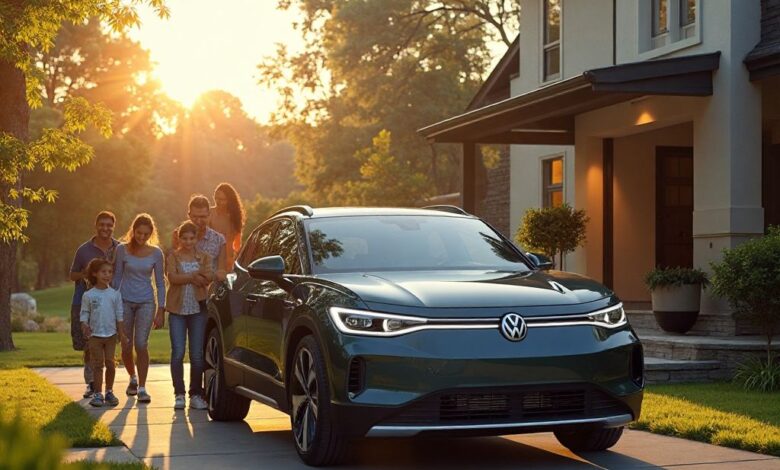
The ID.4’s exterior design is a masterclass in understated modernism. Unlike some EVs that scream for attention with radical lines or overly aggressive styling, the ID.4 adopts a more mature, approachable aesthetic. It’s clearly futuristic, with sleek LED light signatures, flush door handles, and a smooth, aerodynamic profile, yet it retains a familiar Volkswagen sensibility. The front fascia, devoid of a traditional grille, features a clean, illuminated VW badge that connects to the LED headlights, creating a distinctive nighttime signature. The roofline gently slopes towards the rear, giving it a slightly sportier stance than a traditional boxy SUV, but without compromising rear headroom. It’s a design that ages gracefully, avoids fads, and looks equally at home in a suburban driveway or a city parking garage. While it might not turn heads like a Rivian R1S or a Porsche Taycan, its clean lines and confident posture exude a quiet confidence that many buyers will appreciate.
Performance: Comfortable Cruiser, Not a Corner Carver
Underneath its composed exterior, the ID.4 offers a driving experience tailored for comfort and efficiency, rather than outright exhilaration. Most ID.4 models come with a single rear-mounted electric motor producing 201 horsepower and 229 lb-ft of torque, driving the rear wheels. This setup provides brisk, linear acceleration, allowing the ID.4 to sprint from 0-60 mph in a respectable 7.6 seconds. It’s more than adequate for merging onto highways or zipping around town. For those seeking more punch, the available AWD Pro models add a front motor, boosting total output to 295 horsepower and 339 lb-ft, dropping the 0-60 mph time to a much quicker 5.7 seconds – putting it squarely in contention with many gasoline-powered performance SUVs.
The ride quality is a standout feature. Thanks to its well-tuned suspension and the low center of gravity afforded by the battery pack, the ID.4 glides over imperfections with impressive composure. It’s quiet, refined, and exceptionally comfortable, making long journeys a breeze. Steering is light and precise, though it lacks the tactile feedback that enthusiasts might crave. Body roll is well-managed for a vehicle of its stature, but don’t mistake it for a GTI; it’s not designed to carve corners with gusto. Instead, it prioritizes a smooth, stable, and predictable driving experience, perfectly suiting its role as a family hauler. It’s a pleasant, undemanding car to drive, which for many, is exactly what they want in an everyday EV.
Interior: Spacious, Practical, and User-Friendly (Mostly)
Step inside the ID.4, and you’re greeted by a remarkably airy and spacious cabin. The minimalist design philosophy continues here, with a clean dashboard dominated by a central touchscreen and a smaller digital display for the driver. The absence of a transmission tunnel frees up significant floor space, contributing to a sense of openness. Material quality is generally good, with soft-touch surfaces where it matters most, though some plastics lower down can feel a bit hard. Seat comfort is excellent, both upfront and in the rear, with ample head and legroom for four adults, and even five for shorter trips. The panoramic fixed glass roof (available on higher trims) further enhances the feeling of spaciousness.
Cargo capacity is another strong suit. With 30.3 cubic feet behind the rear seats and a generous 64.2 cubic feet with the seats folded flat, the ID.4 offers practical utility that rivals many gasoline-powered compact SUVs. There’s also a useful adjustable load floor and a modest under-floor storage area. Practicality is clearly a core tenet of the ID.4’s interior design, making it an ideal choice for families, grocery runs, and weekend adventures.
Technology: The Elephant in the Room – One Major Weakness
This brings us to the ID.4’s Achilles’ heel, its singular major weakness: the infotainment and user interface experience. While the hardware itself – a 10-inch or optional 12-inch central touchscreen and a 5.3-inch digital gauge cluster attached to the steering column – looks modern, the software running it is, frankly, a significant letdown. It’s often laggy, counter-intuitive, and prone to glitches. Basic functions like climate control are buried in sub-menus or reliant on haptic touch sliders that are difficult to operate accurately while driving. The voice control system is inconsistent, and the overall menu structure feels overly complex and poorly organized.
Even simple tasks, like adjusting the volume or navigating through radio stations, become frustrating exercises. While Apple CarPlay and Android Auto are thankfully standard and can bypass some of these frustrations, they don’t fully alleviate the issues with core vehicle functions. For a car that prides itself on being modern and user-friendly, this software experience feels like a step backward, especially when compared to the slick interfaces found in a Tesla Model Y or even the highly refined systems in a Hyundai Ioniq 5 or Kia EV6. It’s a glaring flaw that detracts from an otherwise excellent vehicle and requires a significant learning curve, often leading to driver distraction and irritation. Volkswagen has promised over-the-air updates to improve the system, but progress has been slow, and the fundamental design remains problematic.
Range, Charging, and Costs: Practical EV Ownership
The ID.4 is built on Volkswagen’s dedicated MEB electric vehicle platform, which houses an 82-kWh battery pack (77 kWh usable). This translates to an EPA-estimated range of around 209-275 miles, depending on the trim and drivetrain (RWD vs. AWD). The long-range RWD Pro S Plus offers the maximum 275 miles, which is more than enough for most daily commutes and even comfortable for many road trips with proper planning. While it doesn’t quite match the segment-leading range of some Tesla Model Y variants, it’s highly competitive with rivals like the Ford Mustang Mach-E and Chevrolet Blazer EV.
When it comes to charging, the ID.4 offers robust capabilities. It supports Level 2 AC charging up to 11 kW, meaning a full charge at home will take around 7.5 to 11 hours, depending on your home charger’s output. For DC fast charging, the ID.4 can accept up to 170 kW, allowing it to charge from 10% to 80% in approximately 30-36 minutes under ideal conditions. While this is good, it’s not as blisteringly fast as the 800-volt architecture found in the Hyundai Ioniq 5 and Kia EV6, which can achieve the same charge in under 20 minutes. Still, for most public charging stops, the ID.4’s charging speed is perfectly adequate.
Pricing for the ID.4 is also competitive, starting in the mid-$40,000 range for the base models and climbing into the mid-$50,000s for fully loaded AWD Pro S Plus versions. It often qualifies for federal tax credits, making it an even more attractive proposition, especially when compared to the higher starting prices of a Tesla Model Y or the premium offerings from Audi (Q4 e-tron) or BMW (iX1, though not available in the US). Running costs are significantly lower than gasoline cars, with electricity proving to be a much cheaper “fuel” source.
Value for Money: A Strong Contender
Considering its spacious interior, comfortable ride, respectable range, and comprehensive feature set, the Volkswagen ID.4 offers excellent value for money in the burgeoning EV market. It undercuts many premium rivals while providing a level of practicality and refinement that makes it a genuinely appealing family vehicle. Its straightforward approach to electrification, combined with the familiarity of the VW brand, makes it a less intimidating jump for those new to EVs. If Volkswagen can address its software shortcomings, the ID.4 would be an undeniable segment leader in terms of overall value.
Expert Analysis: Beyond the Brochure
- The Unsung Hero of the MEB Platform: While the ID.4 is VW’s mainstream EV, it’s important to remember it shares its MEB platform with a host of upcoming and existing EVs from VW Group brands, including the Audi Q4 e-tron and even the upcoming Cupra Born. This common architecture means VW is rapidly iterating and improving the underlying tech, so future ID. models and software updates for the ID.4 should benefit from this ongoing development. It’s a strategic long-term play.
- The “ICE-to-EV” Transition Car: The ID.4’s design and driving dynamics are intentionally non-radical. Volkswagen understood that many buyers transitioning from gasoline cars want familiarity, not a spaceship. This deliberate choice, while sometimes criticized by enthusiasts, is precisely why the ID.4 is so effective at bringing new buyers into the EV fold. It’s an EV that feels like a “normal” car, just electric.
- Charging Network Advantage: While the ID.4’s charging speed isn’t class-leading, Volkswagen’s partnership with Electrify America (born from the Dieselgate settlement) provides ID.4 owners with a significant benefit: often complimentary charging credits and access to a rapidly expanding, reliable network. This is a huge practical advantage over brands without such dedicated infrastructure support.
- The Silent Interior Detail: Pay close attention to the ID.4’s interior acoustics. Volkswagen has done an outstanding job of isolating road and wind noise, even at highway speeds. This, combined with the smooth electric powertrain, creates a serene cabin environment that significantly enhances comfort, especially on longer journeys. It’s a subtle refinement often overlooked in reviews but greatly appreciated by owners.
- The “One-Pedal Drive” Miss: Unlike many competitors (e.g., Tesla, Hyundai, Kia, Chevrolet Bolt EUV), the ID.4 doesn’t offer a true one-pedal driving mode where the car can come to a complete stop using regenerative braking alone. While it has a “B” mode that increases regen, it still requires the brake pedal for a full stop. This is a missed opportunity for maximizing efficiency and convenience, especially in city driving, and is a common complaint among dedicated EV drivers.
Pros and Cons
- Pros:
- Spacious and practical interior with excellent cargo capacity.
- Comfortable and refined ride quality.
- Respectable range and competitive DC fast charging.
- Attractive, understated design.
- Competitive pricing, especially with available incentives.
- Quiet and serene cabin environment.
- Familiar driving dynamics for easy transition from ICE vehicles.
- Cons:
- Major Weakness: Frustrating, laggy, and unintuitive infotainment/software system.
- Lack of a true one-pedal driving mode.
- Some interior plastics feel less premium than expected.
- Driving dynamics are more comfort-oriented than engaging.
- Charging speed, while good, isn’t class-leading compared to 800V rivals.
Final Verdict: A Family EV Worth Considering, With a Caveat
The Volkswagen ID.4 is a deeply competent, practical, and highly livable electric SUV that hits all the right notes for the modern family. It offers ample space, a comfortable ride, solid range, and a design that’s both modern and approachable. It’s a genuine contender for anyone looking to make the leap into electric vehicle ownership without sacrificing the practicality they’ve come to expect from a traditional SUV. It’s a testament to Volkswagen’s commitment to electrification and a strong alternative to pricier, flashier EVs.
However, its single, significant flaw – the deeply flawed infotainment and user interface – casts a shadow over an otherwise brilliant package. It’s a daily frustration that can chip away at the joy of ownership. If you’re someone who values intuitive technology and a seamless digital experience above all else, this might be a deal-breaker. But if you can overlook or adapt to its digital quirks, the ID.4 rewards you with a genuinely solid, enjoyable


